
Valentine
1850–70
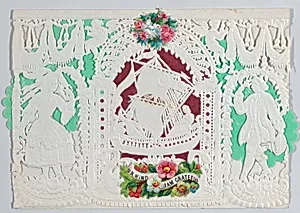
Medium
Open work, cameo embossed lace paper, colored paper, chromolithography
Dimensions
Width: 4 5/8 in. (11.7 cm) Length: 3 1/4 in. (8.3 cm)
Classification
Ephemera|Prints
Department
Drawings and Prints
Museum
Metropolitan Museum of Art, New York, NY
Credit
Gift of Mrs. Richard Riddell, 1981
Accession Number
1981.1136.586
Rights
Public Domain
Art Historical Context
Nestled in the Metropolitan Museum of Art's Drawings and Prints department, this delicateValentine" (185–70) is a example of Victorian-era ephemera. Created, the small card—asuring just 4 5/8 by 3 14 inches—was likely a token exchanged on Valentine's Day. Its intricate medium combines open work, cameo-embossed lace paper, paper, and chromolith, showcasing the era's innovative printing techniques that brought affordable romance to the masses. Chromolithography, a color lithography process perfected in the mid-19th century, allowed for vibrant, multi-hued designs on paper, while cameo embossing created raised, sculptural motifs resembling fine jewelry cameos. The lace-like open work added a feminine, ornamental touch, mimicking handmade crafts amid the Industrial Revolution's rise of mass-produced sentiment. As a gift to the museum in 1981, this piece highlights the cultural boom of Valentine's cards in America and Europe, transforming personal love letters into accessible, artistic expressions of affection. It invites us to appreciate how everyday ephemera captured the tender emotions of a bygone age.
About the Artist
Anonymous
In the vast tapestry of art history, "Anonymous" stands not as a singular individual but as a collective designation for countless unidentified creators whose works have endured across millennia. These artists, spanning prehistoric cave painters to medieval illuminators and folk craftsmen, produced the foundational layers of human visual culture. Prior to the Renaissance, when individual fame emer...