
Valentine
1859–69
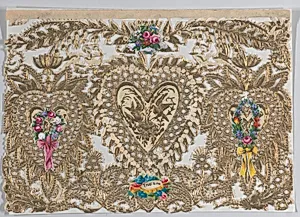
Medium
Cameo-embossed, open-work, gilded lace paper, chromolithography, die-cut scraps
Dimensions
Width: 5 5/16 in. (13.5 cm) Length: 3 3/4 in. (9.5 cm)
Classification
Ephemera|Drawings|Ornament & Architecture
Department
Drawings and Prints
Museum
Metropolitan Museum of Art, New York, NY
Credit
Gift of Mrs. Richard Riddell, 1981
Accession Number
1981.1136.646
Rights
Public Domain
Art Historical Context
Step into the sentimental world of Victorian romance with *Valentine*, an exquisite anonymous greeting card from 1859–69, now housed in the Metropolitan Museum of Art's Drawings and Prints department. just 5 5/16 by 3 3/4 inches, this diminutive treasure bursts with intricate details crafted from cameo-embossed, open-work gilded lace paper, enhanced by vibrant chromolithography and die-cut scraps. These layered techniques create a delicate, three-dimensional effect, evoking lace doilies and floral bouquets that flutter with affection. Produced during the height of Valentine's Day fervor in mid-19th-century America and Europe, such ephemera marked the rise of mass-produced sentimental cards. Chromolithography, a revolutionary color printing method, allowed affordable yet lavish designs to flood the market, transforming personal love notes into accessible tokens of emotion. Classified under ornament and architecture, *Valentine* showcases the era's obsession with decorative excess, blending folk craft with emerging industrial precision. Gifted to the Met in 1981 by Mrs. Richard Riddell, this fragile survivor highlights how everyday objects captured the cultural heartbeat of courtship rituals. Imagine slipping it into an envelope—its gilded edges shimmering under candlelight, a whisper of eternal devotion from a bygone age.
About the Artist
Anonymous
In the vast tapestry of art history, "Anonymous" stands not as a singular individual but as a collective designation for countless unidentified creators whose works have endured across millennia. These artists, spanning prehistoric cave painters to medieval illuminators and folk craftsmen, produced the foundational layers of human visual culture. Prior to the Renaissance, when individual fame emer...