
Valentine
ca. 1880
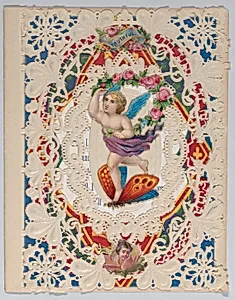
Medium
Cameo-embossed open-work lace paper, chromolithography, die-cut scrap
Dimensions
Width: 3 5/8 in. (9.2 cm) Length: 4 5/8 in. (11.7 cm)
Classification
Ephemera|Drawings|Ornament & Architecture
Department
Drawings and Prints
Museum
Metropolitan Museum of Art, New York, NY
Credit
Gift of Mrs. Richard Riddell, 1981
Accession Number
1981.1136.657
Rights
Public Domain
Art Historical Context
Step into the tender world of Victorian romance with *Valentine*, a delicate anonymous creation from around 1880. Measuring just 3⅝ by 4⅝ inches, this petite ephemera masterpiece captures the era's obsession with sentimental greetings. Crafted from cameo-embossed open-work paper—a technique that mimics intricate handmade lace through raised relief and cut-out patterns—it features vibrant chromolithography for colorful details and die-cut scraps for ornate, lacy edges. These methods allowed for affordable, mass-produced beauty, transforming simple paper into a luxurious token of affection. In the late 19th century, valentines like this were a cultural phenomenon, exchanged by sweethearts and friends during the height of Valentine's Day fervor. Chromolithography, a pioneering color-printing process, brought vivid hues to everyday paper goods, while die-cutting enabled precise, decorative shapes popular in scrapbooks and greeting cards. Collected by enthusiasts and preserved as folk art, such pieces highlight the democratization of ornamentation—once the domain of elites—now accessible to all. Housed in the Metropolitan Museum of Art's Drawings and Prints department, this gift from Mrs. Richard Riddell in 1981 exemplifies the charm of fleeting Victorian ephemera, reminding us how a small, heartfelt object could convey enduring love.
About the Artist
Anonymous
In the vast tapestry of art history, "Anonymous" stands not as a singular individual but as a collective designation for countless unidentified creators whose works have endured across millennia. These artists, spanning prehistoric cave painters to medieval illuminators and folk craftsmen, produced the foundational layers of human visual culture. Prior to the Renaissance, when individual fame emer...