
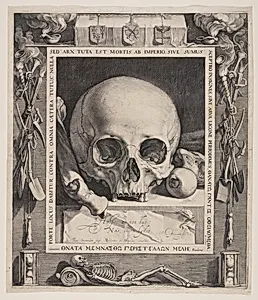
Vanitas
c. 1600
Medium
Engraving on ivory laid paper
Dimensions
Plate: 37.1 × 30.9 cm (14 5/8 × 12 3/16 in.); sheet: 34.5 × 33 cm (13 5/8 × 13 in.)
Classification
Department
Prints and Drawings
Museum
Art Institute of Chicago
Accession Number
268631
Rights
Public Domain
Art Historical Context
Jan Saenredam’s *Vanitas*, created around 1600, exemplifies the Dutch fascination with mortality during the early Golden Age. As an engraving on ivory laid paper, the work belongs to a tradition of reproductive prints that allowed complex allegorical imagery to reach wide audiences beyond elite. Saenredam, a skilled Northern Netherlandish engraver, translated designs into crisp, luminous lines that reward close looking even in this intimate scale. The title signals the vanitas theme, a reminder of life’s transience popular in Protestant Europe. Through symbolic objects—typically skulls, wilting flowers, hourglasses, or extinguished candles—such images encouraged viewers to reflect on earthly pleasures versus eternal salvation. Saenredam’s precise technique heightens this message: every delicate hatch and polished surface invites contemplation of both beauty and its inevitable decay. Today the print resides in the Art Institute of Chicago’s collection of works on paper, where its modest size and refined detail continue to draw visitors into quiet meditation on time and impermanence.
About the Artist
Jan Saenredam · 1565–1607
Jan Pieterszoon Saenredam (c. 1565–1607) emerged from humble beginnings in the Dutch village of Assendelft, where he was orphaned young and raised by his uncle, the local bailiff Pieter de Jongh. Initially destined for basket weaving or farm work, Saenredam's precocious talent for embellishing texts with intricate designs caught attention, leading to an apprenticeship in cartography. By 1589, at a...