
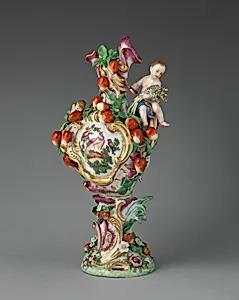
Vase
ca. 1760
Medium
Soft-paste porcelain
Dimensions
Height: 13 1/4 in. (33.7 cm)
Classification
Ceramics-Porcelain
Culture
British, Chelsea
Department
European Sculpture and Decorative Arts
Museum
Metropolitan Museum of Art, New York, NY
Credit
Bequest of John L. Cadwalader, 1914
Accession Number
14.58.98
Rights
Public Domain
Tags
Art Historical Context
This elegant vase from the Chelsea Porcelainufactory, dating to around 1760, exemplifies the of British porcelain production during the 18th-century "porcelain fever." Chelsea, one of England's earliest porcelain factories founded in the 1740s, in soft-paste porcelain delicate, translucent material made from white clay mixed with ground glass, fired at lower temperatures than true Chinese hard-paste. This innovation allowed intricate molding and vibrant enamel colors, making Chelsea wares highly prized by the aristocracy for their exotic appeal and technical finesse. Adorned with lively motifs of birds, fruit, children, and flowers, the vase captures the playful exuberance of the Rococo style popular in mid-Georgian England. These decorative elements, hand-painted in rich enamels and often gilded, evoke abundance and nature's bounty, reflecting the era's fascination with chinoiseries and pastoral fantasies. Standing at 13¼ inches tall, its graceful form showcases the manufactory's mastery during its prestigious "Gold Anchor" period. Now part of the Metropolitan Museum of Art's European Sculpture and Decorative Arts collection, thanks to the 1914 bequest of John L. Cadwalader, this piece highlights Chelsea's brief but brilliant legacy before its closure in 1769. It stands as a testament to Britain's drive to rival continental porcelain giants like Sèvres and Meissen.
About the Artist
Chelsea Porcelain Manufactory · 1744–1784
**Chelsea Porcelain Manufactory** The Chelsea Porcelain Manufactory, Britain's pioneering porcelain enterprise, was founded around 1743 in Chelsea, London, by two Huguenot silversmiths: Nicholas Sprimont from Liège and Charles Gouyn. Sprimont, trained in Paris as a goldsmith before immigrating to England, brought his expertise in luxury metalwork to the venture, while Gouyn handled early sales th...