
Vase
ca. 1897–1900
Medium
Earthenware
Dimensions
6 1/8 x 4 1/2 in. (15.6 x 11.4 cm)
Classification
Vase
Culture
American
Department
The American Wing
Museum
Metropolitan Museum of Art, New York, NY
Credit
Gift of Robert A. Ellison Jr., 2018
Accession Number
2018.294.174
Rights
Public Domain
Art Historical Context
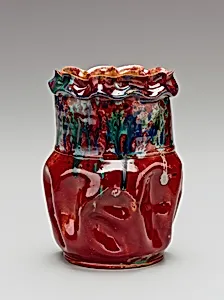
George E. Ohr's *Vase* (ca. 1897–1900) exemplifies the bold experimentation of one of America's most eccentric ceramicists, known as the " Potter of Biloxi." in Mississippi during the late 19th, Ohr produced thousands of earthenware vessels that challenged the symmetrical, mass-produced pottery of his era. This small earthenware piece, measuring just 6 1/8 x 4 1/2 inches, reflects his self-taught mastery in a time when American decorative arts were gaining prominence amid the Arts and Crafts movement. Ohr's techniques were revolutionary: he threw clay to razor-thin walls, often distorting forms by hand and employing high-fire reduction techniques that yielded metallic lusters, crackled glazes, and iridescent surfaces on everyday earthenware—a low-fired, accessible medium. These methods anticipated modern studio pottery, emphasizing individual artistry over industrial perfection. Housed in the Metropolitan Museum of Art's American Wing as a 2018 gift from Robert A. Ellison Jr., this vase highlights Ohr's cultural legacy. Tragically, he destroyed much of his own work late in life, making survivors like this one rare treasures that celebrate American innovation and the potter's unbridled creativity.
About the Artist
George E. Ohr · 1857–1918
**George Edgar Ohr (1857–1918)** was an American ceramic artist renowned as the self-proclaimed “Mad Potter of Biloxi.” Born in Biloxi, Mississippi, to German immigrant parents—his father a blacksmith and his mother a grocer—he grew up in a working-class environment with little formal education. Ohr apprenticed under Joseph Fortune Meyer, a family friend and potter associated with the New Orleans...