
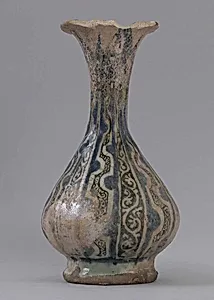
Vase
Unknown Artist
14th century
Medium
Stonepaste; underglaze painted
Dimensions
H. 8 7/8 in. (22.5 cm) Max. Diam. 4 13/16 in. (12.2 cm)
Classification
Ceramics
Department
Islamic Art
Museum
Metropolitan Museum of Art, New York, NY
Credit
Rogers Fund, 1908
Accession Number
08.110.3
Rights
Public Domain
Art Historical Context
This elegant 14th-century vase crafted from stonepaste with underglaze painting, the ingenuity of Islamic ceramic traditions. Standing just 8⅞ inches tall with a maximum diameter of ⅞ inches, its compact form suggests it was designed for intimate domestic use, perhaps holding spices, flowers, or oils in a wealthy household. Stonepaste—a composite of quartz, clay, and frit—allowed artisans to create a fine, porcelain-like body that was both lightweight and durable, a remarkable innovation in the Islamic world where true porcelain was unavailable. The underglaze technique, where pigments are applied directly to the unfired body before a transparent glaze is added and the piece is fired, ensured vibrant, long-lasting colors resistant to wear. Flourishing in regions like Iran and Syria during the 14th century, this method marked a shift toward bolder, more affordable decoration compared to earlier lusterware, reflecting the era's cultural exchange along Silk Road trade routes. Acquired through the Rogers Fund in 1908 and now housed in the Metropolitan Museum of Art's Islamic Art Department, this anonymous masterpiece invites us to appreciate the unsung skill of medieval potters, whose vessels bridged utility and artistry in everyday life.