
Jar
Unknown Artist
late 12th–first half 13th century
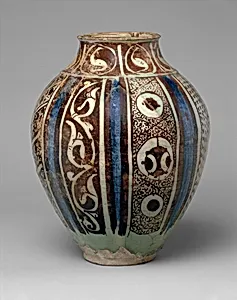
Medium
Stonepaste; painted in luster and blue on opaque white glaze under transparent colorless glaze
Dimensions
H. 16 1/4 in. (41.3 cm) Max. Diam. 13 1/2in. (34.3cm)
Classification
Ceramics
Department
Islamic Art
Museum
Metropolitan Museum of Art, New York, NY
Credit
H.O. Havemeyer Collection, Gift of Horace Havemeyer, 1948
Accession Number
48.113.4
Rights
Public Domain
Tags
Art Historical Context
This elegant jar, crafted by an unknown artist in the 12th to first half of the 13 century, exemplifies the pinnacle of medieval Islamic ceramic artistry. Standing 16¼ inches tall with a maximum diameter of 13½ inches, it was made from stonepaste—a composite of quartz, clay, and frit that allowed for thin, translucent bodies mimicking Chinese porcelain, which was highly prized but unavailable in the Islamic world. Housed in the Metropolitan Museum of Art's Art Department, it entered the collection through the H.O. Havemeyer Collection, gift of Horace Havemeyer in 1948. The jar's surface dazzles with luster painting in metallic tones and blue motifs applied over an opaque white glaze, then sealed under a transparent colorless glaze. Lusterware, developed in 9th-century Iraq and refined in centers like Syria and Iran, involved firing the piece multiple times: first to set the base glaze, then adding luster pigments reduced in a low-oxygen kiln to produce a shimmering, iridescent effect. This labor-intensive technique signified luxury, reserved for elite households or as diplomatic gifts. Culturally, such jars served practical yet prestigious roles—storing perfumes, spices, or sweets—while showcasing Islamic innovation in the arts during the Seljuk era. Their intricate designs often drew from nature and geometry, reflecting a sophisticated aesthetic that bridged utility and beauty, influencing ceramics across Eurasia.