
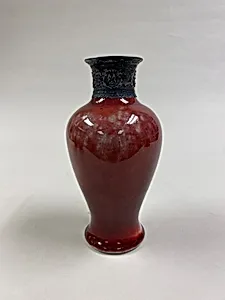
Vase
Unknown Artist
late 17th–early 18th century
Medium
Porcelain with copper red glaze (Jingdezhen ware), silver mounts
Dimensions
H. 8 1/8 in. (20.8 cm); Diam. 4 in. (10.2 cm)
Classification
Ceramics
Culture & Period
China · Qing dynasty (1644–1911), Kangxi period (1662–1722)
Department
Asian Art
Museum
Metropolitan Museum of Art, New York, NY
Credit
Bequest of Benjamin Altman, 1913
Accession Number
14.40.105
Rights
Public Domain
Art Historical Context
This exquisite small vase, crafted in Jingdezhen—the porcelain capital of China—dates to the late 17th to early 18th century the Kangxi period of the Qing dynasty (1662–1722). just over 8 inches tall, it exemplifies the era's mastery of ceramics, when imperial kilns produced wares of unparalleled refinement for the court and export markets. The deep, vibrant copper red glaze, known as sang de bœuf for its blood-like hue, was achieved through precise control of copper oxide in the firing process, a technically challenging feat that resulted in a luminous, crackled surface. Jingdezhen porcelain was prized worldwide for its translucency and durability, fueling global trade along the Silk Road and maritime routes. The addition of European-style silver mounts—likely added later in the West—transforms this vessel into a hybrid luxury object, blending Chinese artistry with continental opulence. Such adaptations were common for elite collectors, highlighting the vase's role in cultural exchange. Bequeathed to the Metropolitan Museum of Art by Benjamin Altman in 1913, this piece invites us to appreciate the Kangxi reign's artistic zenith, a time when porcelain symbolized imperial power and technical innovation.