
Vase
ca. 1897–1900
Medium
earthenware
Dimensions
H. 9 1/2 in.
Classification
Vase
Culture
American
Department
The American Wing
Museum
Metropolitan Museum of Art, New York, NY
Credit
Gift of Martin Eidelberg, 2017
Accession Number
2017.444.2
Rights
Public Domain
Art Historical Context
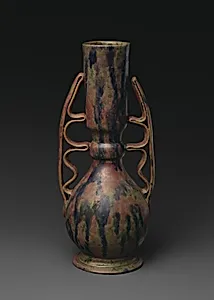
George E. Ohr, innovative American potter from Biloxi, Mississippi, created this striking vase around 1897–1900. Often called the “Mad Potter Biloxi,” Ohr worked during a time when American ceramics were shifting toward more expressive, studio-based practices. His pieces stand out for their playful manipulation of form, reflecting a bold departure from conventional pottery of the era. Made of earthenware, the vase showcases Ohr’s experimental approach to the medium. He frequently used local clays and pushed the material’s limits by throwing exceptionally thin walls and then twisting or folding them into unexpected shapes. This technique gave his works a lively, sculptural quality that anticipated later developments in modern ceramic art. Now part of the Metropolitan Museum of Art’s American Wing, the piece highlights Ohr’s lasting influence on American decorative arts. Its modest scale and inventive surface treatment invite viewers to appreciate how everyday functional objects could become vehicles for personal artistic expression at the turn of the twentieth century.
About the Artist
George E. Ohr · 1857–1918
**George Edgar Ohr (1857–1918)** was an American ceramic artist renowned as the self-proclaimed “Mad Potter of Biloxi.” Born in Biloxi, Mississippi, to German immigrant parents—his father a blacksmith and his mother a grocer—he grew up in a working-class environment with little formal education. Ohr apprenticed under Joseph Fortune Meyer, a family friend and potter associated with the New Orleans...