
Vase
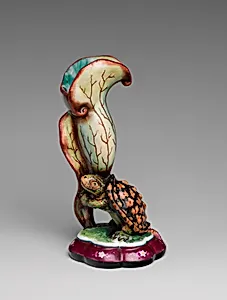
Medium
Porcelain
Dimensions
H. 8 5/8 in. (21.9 cm); Diam. 4 3/8 in. (11.1 cm)
Classification
Vase
Culture
American
Department
The American Wing
Museum
Metropolitan Museum of Art, New York, NY
Credit
Gift of Florence I. Balasny-Barnes, in memory of her sister, Yvette B. Gould, 1984
Accession Number
1984.443.9
Rights
Public Domain
Tags
Art Historical Context
This elegant porcelain vase, crafted by the Union Porcelain Works in 187, exemplifies the burgeoning American ceramics industry during the Gilded Age. Founded in the late 1860s in Greenpoint, Brooklyn, Porcelain Works was among the first U.S. manufacturers to produce high-quality, hard-paste porcelain, rivaling imports like those from Sèvres or Meissen. Standing at 8⅝ inches tall with a4⅜-inch diameter, this compact piece was likely designed for domestic display, reflecting the era's fascination with refined tableware and decorative objects. Adorned with turtle motifs—evident from its tagging—this vase highlights naturalistic themes popular in the Aesthetic Movement, which emphasized beauty in everyday items. Turtles, symbols of longevity and resilience in various cultures, add a whimsical yet sophisticated touch, achieved through meticulous underglaze painting and gilding techniques typical of the firm's output. Displayed in The American Wing of the Metropolitan Museum of Art, it celebrates American ingenuity and the donor's generosity: a 1984 gift from Florence I. Balasny-Barnes in memory of her sister, Yvette B. Gould. As a snapshot of 19th-century innovation, the vase invites visitors to appreciate how American artisans blended industrial precision with artistic flair, bridging utility and ornament in post-Civil War prosperity.
About the Artist
Union Porcelain Works · 1863–1922
Union Porcelain Works, established in Greenpoint, Brooklyn, New York, in 1863, marked America's breakthrough in hard-paste porcelain production. Architect and builder Thomas Carll Smith (1815–1901) acquired the struggling factory from earlier owners like William Boch & Brothers after it faltered during the Civil War. In 1863, Smith traveled to Europe, studying porcelain techniques at the Manufactu...