
Vase
Unknown Artist
1830–70
Medium
Parian porcelain
Dimensions
10 3/4 x 4 7/8 x 4 3/4 in. (27.3 x 12.4 x 12.1 cm)
Classification
Vase
Culture
American
Department
The American Wing
Museum
Metropolitan Museum of Art, New York, NY
Credit
Gift of Dr. Charles W. Green, 1947
Accession Number
47.90.4
Rights
Public Domain
Tags
Art Historical Context
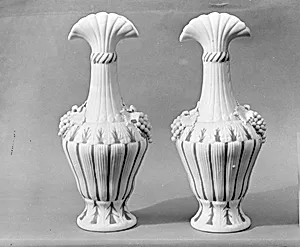
This elegant vase, crafted by an unknown American artist between 1830 and 1870, exemplifies the refined decorative arts of mid-19th-century America. Standing at just over 10 inches tall, its graceful form and subtle curves make it a perfect display piece for Victorian parlors, now housed in The Metropolitan Museum of Art's American Wing. A tag noting grapes suggests naturalistic motifs—likely sculpted or molded clusters evoking abundance and classical themes, common in period ceramics. Made of Parian porcelain, a fine, unglazed bisque ware that imitates the soft glow of Parian marble from the Greek island of Paros, this medium rose to popularity in the 1840s–70s. American potteries vied with European imports to produce these matte-white masterpieces, prized for their sculptural quality and neoclassical appeal. Unlike glossy glazed porcelain, Parian's velvety texture invited touch, bridging fine art and everyday luxury. As a gift to the Met from Dr. Charles W. Green in 1947, this vase highlights the burgeoning American ceramics industry during an era of national pride and industrial innovation. It reflects how middle-class households aspired to European elegance, using such objects to adorn homes and symbolize prosperity. A quiet testament to overlooked craftsmanship, it invites visitors to appreciate the artistry in everyday beauty.