
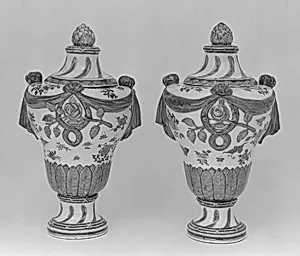
Pair of urns
Unknown Artist
1775–85
Medium
Hard-paste porcelain
Dimensions
Height (with cover .38a, b): 16 7/16 in. (41.8 cm); Height (with cover .39a, b): 16 9/16 in. (42.1 cm)
Classification
Ceramics-Porcelain-Export
Culture
Chinese, for Swedish market
Department
European Sculpture and Decorative Arts
Museum
Metropolitan Museum of Art, New York, NY
Credit
Helena Woolworth McCann Collection, Gift of Winfield Foundation, 1951
Accession Number
51.86.38a, b, .39a, b
Rights
Public Domain
Art Historical Context
These elegant pair of urns, crafted in hard-paste porcelain 1775 and 1785, exemplify the pinnacle of Chinese export ceramics tailored for European tastes—in this case, the Swedish market. Standing over 16 inches tall with their fitted covers, the urns feature delicate motifs of roses and leaves, blending Eastern technical mastery with Western floral inspirations. Hard-paste porcelain, a secret Chinese formula prized for its translucency, strength, and pure white body, allowed for intricate molding and firing at high temperatures, making these pieces both functional and luxurious display objects. Produced during the height of global trade via the Canton system, these urns highlight China's role as the world's leading porcelain exporter in the late 18th century. Swedish collectors, enamored with chinoiserie, sought such customized wares that evoked exotic opulence for grand homes and cabinets of curiosities. The subtle adaptation of European rose-and-leaf designs on these vessels reflects cultural exchange, bridging Qing dynasty artistry with Scandinavian refinement. Today, housed in The Metropolitan Museum of Art's European Sculpture and Decorative Arts department, these urns from the Helena Woolworth McCann Collection invite us to ponder the silk roads of taste that connected distant empires through beauty and commerce.