
Vase
Unknown Artist
1830–70
Medium
Parian porcelain
Dimensions
H. 8 1/2 in. (21.6 cm)
Classification
Vase
Culture
American
Department
The American Wing
Museum
Metropolitan Museum of Art, New York, NY
Credit
Gift of Dr. Charles W. Green, 1947
Accession Number
47.90.34
Rights
Public Domain
Tags
Art Historical Context
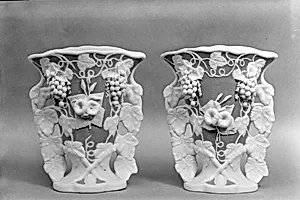
This elegant Parian porcelain vase, created by an unknown American artist between 1830 1870, exemplifies the refined decorative arts of mid-19-century America. Standing at 8½ inches tall, it hails from a period when American potters emulated European styles, particularly the neoclassical elegance of Wedgwood and Staffordshire wares. Now housed in The American Wing of the Metropolitan Museum Art, it was generously gifted by Dr. Charles. Green in 1947. Parian porcelain, named after the white marble of Paros, Greece, is an unglazed bisque material prized for its smooth, matte surface that mimics sculpted marble. This technique allowed artisans to craft delicate, lifelike forms without the sheen of glaze, making it ideal for vases like this one, adorned with motifs of grapes and flowers. These naturalistic decorations reflect Victorian-era tastes for abundance and nature, symbolizing prosperity and the American landscape's bounty. Though the maker remains anonymous—common for utilitarian yet artistic objects of the time—this vase highlights the growing sophistication of U.S. ceramics during industrialization. Visitors will appreciate its subtle beauty, a testament to everyday luxury in antebellum homes.