
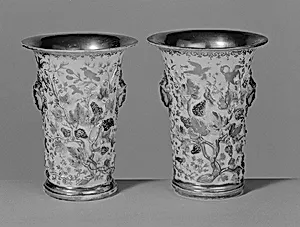
Pair of beaker vases
ca. 1725, decorated ca. 1725–30
Medium
Hard-paste porcelain
Dimensions
.149: 5 3/8 × 4 1/8 in. (13.7 × 10.5 cm); .150: 5 3/8 × 4 1/4 in. (13.7 × 10.8 cm)
Classification
Ceramics-Porcelain
Culture
German, Meissen with probably Augsburg decoration
Department
European Sculpture and Decorative Arts
Museum
Metropolitan Museum of Art, New York, NY
Credit
Gift of Irwin Untermyer, 1964
Accession Number
64.101.149, .150
Rights
Public Domain
Tags
Art Historical Context
Welcome to the European Sculpture and Decorative Arts, where you'll find this exquisite *Pair of Beaker Vases* from the Meissen Manufactory, around 1725 and decorated circa 1725–30. Standing just over 5 inches tall, these petite hard-paste porcelain vessels exemplify the early mastery of Meissen, Europe's first factory to produce true porcelain akin to prized Chinese imports. Founded in 1710 under Augustus the Strong, Elector of Saxony, Meissen revolutionized ceramics by cracking the secret formula for durable, translucent hard-paste porcelain, sparking a frenzy across the continent. The vases likely feature vibrant grape motifs, painted probably in Augsburg, a hub for specialized decorators who embellished Meissen's pristine white bodies with intricate Hausmalerei (outside decoration). This collaborative technique highlights the rococo era's love for naturalistic abundance and luxury—grapes symbolizing opulence and the vine's classical associations. Their slender, beaker-like forms were ideal for floral arrangements or as display pieces in grand 18th-century interiors. Gifted to The Metropolitan Museum of Art by Irwin Untermyer in 1964, these vases capture a pivotal moment when European artisans rivaled Asia's dominance, blending technical innovation with artistic flair for the elite collector.
About the Artist
Meissen Manufactory · 1710–present
The Meissen Manufactory, established on June 6, 1710, by Augustus the Strong, Elector of Saxony and King of Poland, marked the dawn of true hard-paste porcelain production in Europe. Nestled at Albrechtsburg Castle in Meissen near Dresden, the Royal Polish and Electoral Saxon Porcelain Manufactory arose from alchemical experiments begun in 1708 by physicist Ehrenfried Walther von Tschirnhaus and p...