
Vase
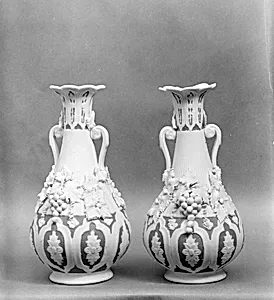
Medium
Parian porcelain
Dimensions
H. 9 3/4 in. (24.8 cm)
Classification
Vase
Culture
American
Department
The American Wing
Museum
Metropolitan Museum of Art, New York, NY
Credit
Gift of Dr. Charles W. Green, 1947
Accession Number
47.90.12
Rights
Public Domain
Tags
Art Historical Context
This elegant vase, crafted by the United States Pottery Company between 1849 and 1858, exemplifies the early achievements of American ceramic production. Standing just under ten inches tall, the piece is made of Parian porcelain, a fine, unglazed material prized for its smooth, marble-like texture. Popular in the mid-nineteenth century, this medium allowed American makers to create delicate relief decorations—here, the tag “Grapes” suggests clusters of fruit and vines that evoke abundance and natural beauty. During this period, the United States Pottery Company in Bennington, Vermont, helped establish a distinctly American voice in decorative arts. Working in an era when the nation was expanding its industrial capabilities, the company produced affordable yet refined wares that brought European-inspired elegance into middle-class homes. The vase’s modest scale and graceful grape motif reflect the Victorian taste for naturalistic ornament while showcasing the technical skill of American potters who adapted Parian techniques to local clays and tastes. Today in the Metropolitan Museum’s American Wing, the object serves as a quiet reminder of the country’s growing confidence in design and craftsmanship. Donated in 1947 by Dr. Charles W. Green, it invites visitors to appreciate how everyday objects once carried both aesthetic pleasure and cultural ambition.