
Vase
Qing dynasty (1644–1911)
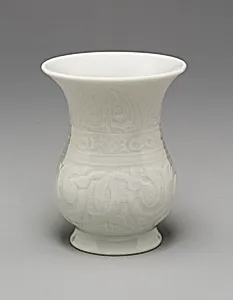
Medium
Porcelain with underglaze molded decoration
Dimensions
8.3 × 6.5 cm (3 1/4 × 2 9/16 in.); Diam.: 6.5 cm (2 9/16 in.)
Classification
porcelain
Department
Arts of Asia
Museum
Art Institute of Chicago
Accession Number
42665
Rights
Public Domain
Art Historical Context
This delicate porcelain vase, crafted during China's Qing dynasty (1644–1911), exemplifies the era's mastery of ceramic arts. The Qing period marked the zenith of imperial porcelain production, particularly at Jingdezhen kilns, where potters supplied the court and global markets with refined wares. Symbolizing luxury and technical prowess, such vases were prized for their flawless white bodies and subtle elegance, often used for floral arrangements, incense, or display in scholarly studios. The vase's medium—porcelain with underglaze molded decoration—highlights innovative techniques. Molded forms allowed for precise, repeating patterns applied in cobalt blue or other pigments beneath a clear glaze, fired at high temperatures for a durable, luminous finish. At just 8.3 × 6.5 cm, its petite scale suggests it was a personal treasure rather than a grand vessel, showcasing the Qing artisans' skill in miniaturization. Housed in the Art Institute of Chicago's Arts of Asia department, this anonymous work invites us to appreciate the cultural sophistication of Qing China, where porcelain bridged art, trade, and daily refinement. Though its exact motifs remain unnoted, it whispers of an age when clay became timeless poetry.
About the Artist
Unknown
The artist designated as "Unknown" in our virtual museum's collection exemplifies a poignant chapter in art history: creators whose identities have faded into obscurity despite the enduring power of their work. With only one known artwork attributed to them in our holdings, this figure represents countless anonymous hands that shaped visual culture across centuries. Museums worldwide, including th...