
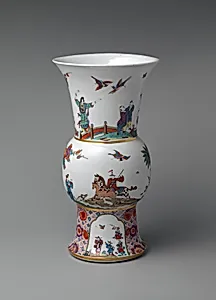
Vase (one of a pair)
ca. 1735
Medium
Hard-paste porcelain decorated in polychrome enamels, gold
Dimensions
Height: 18 5/16 in. (46.5 cm); Diameter (rim): 9 11/16 in. (24.6 cm)
Classification
Ceramics-Porcelain
Culture
German, Meissen
Department
European Sculpture and Decorative Arts
Museum
Metropolitan Museum of Art, New York, NY
Credit
Gift of Irwin Untermyer, 1964
Accession Number
64.101.147
Rights
Public Domain
Tags
Art Historical Context
This elegant vase, one of a pair crafted by the renowned Meissen Manufactory 1735, exemplifies the pinnacle of early European porcelain artistry. Produced in Germany at the factory founded in 1710—the first in Europe to successfully replicate Chinese hard-paste porcelain— medium of hard-paste porcelain,antly decorated in polychrome enamels and, stands about 18 inches tall. The collaboration with painter Peter Schenk highlights Meissen's mastery of intricate overglaze painting, a technique that allowed for lifelike colors fired at low temperatures to create enduring, jewel-like surfaces. Adorned with lively scenes of human figures engaged in hunting pursuits amid birds and fluttering butterflies, the vase captures the exuberant Rococo spirit of the era, blending naturalism with playful fantasy. These motifs, drawn from European decorative traditions, transformed functional objects into status symbols for 18th-century aristocracy, rivaling the finest Asian imports. The generous scale and gilded details underscore its role as a luxurious centerpiece. Today, this gift to the Metropolitan Museum of Art from Irwin Untermyer in 1964 invites visitors to marvel at Meissen's innovation, bridging technical prowess with artistic delight in the European Sculpture and Decorative Arts collection.
About the Artist
Meissen Manufactory|Peter Schenk · 1710–present
The Meissen Manufactory, established on June 6, 1710, by Augustus the Strong, Elector of Saxony and King of Poland, marked the dawn of true hard-paste porcelain production in Europe. Nestled at Albrechtsburg Castle in Meissen near Dresden, the Royal Polish and Electoral Saxon Porcelain Manufactory arose from alchemical experiments begun in 1708 by physicist Ehrenfried Walther von Tschirnhaus and p...