
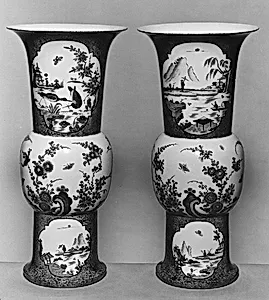
Vase (one of a pair)
Medium
Hard-paste porcelain
Dimensions
Each, H. 15 in. (38.1 cm.); Diam. 7 in. (17.8 cm.)
Classification
Ceramics-Porcelain
Culture
German, Meissen
Department
European Sculpture and Decorative Arts
Museum
Metropolitan Museum of Art, New York, NY
Credit
Gift of Irwin Untermyer, 1964
Accession Number
64.101.138
Rights
Public Domain
Tags
Art Historical Context
This elegant pair of vases, by the renowned Meissen Manufactory 1730 and painted by Johann Ehrenfried Stad, exemplifies the pinnacle of early European porcelain artistry. Standing 15 inches tall with a 7-inch diameter these hard-paste porcelain treasures were produced in Meissen, Germany—the first site to successfully replicate the secret of Chinese hard-paste porcelain in 1710. This breakthrough ended Europe's dependence on costly Asian imports, sparking a decorative arts revolution during the Rococo era. Meissen's innovative technique involved firing kaolin-based clay at high temperatures for a durable, translucent body, then applying intricate overglaze enamels and gilding. Stadler's delicate motifs of birds, flowers, and boats evoke a whimsical natural world, blending realism with playful fantasy—a hallmark of the manufactory's Hausmaler tradition, where outside artists like him enhanced factory pieces. These vases would have graced aristocratic tables or cabinets, symbols of wealth and refined taste. Today, gifted to the Metropolitan Museum of Art in 1964 by Irwin Untermyer, they highlight Meissen's enduring cultural legacy: transforming functional ceramics into high art that rivaled painting and sculpture. Visitors, imagine these glowing softly in candlelight, alive with vibrant life!
About the Artist
Meissen Manufactory|Johann Ehrenfried Stadler · 1710–present
The Meissen Manufactory, established on June 6, 1710, by Augustus the Strong, Elector of Saxony and King of Poland, marked the dawn of true hard-paste porcelain production in Europe. Nestled at Albrechtsburg Castle in Meissen near Dresden, the Royal Polish and Electoral Saxon Porcelain Manufactory arose from alchemical experiments begun in 1708 by physicist Ehrenfried Walther von Tschirnhaus and p...