
Vase (one of a pair)
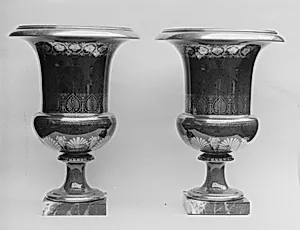
Medium
Hard-paste porcelain
Dimensions
12 1/2 × 9 in. (31.8 × 22.9 cm)
Classification
Ceramics-Porcelain
Culture
French, Sèvres
Department
European Sculpture and Decorative Arts
Museum
Metropolitan Museum of Art, New York, NY
Credit
Rogers Fund, 1926
Accession Number
26.223.2
Rights
Public Domain
Tags
Art Historical Context
This exquisite vase, one of a pair crafted in 1825 by the renowned Sèvres Manufactory with decoration attributed to Richard, exemplifies the pinnacle of French porcelain artistry during the Bourbon Restoration. Standing at 12½ × 9 inches, it is fashioned from hard-paste porcelain—a durable, translucent material perfected by Sèvres in the late 18th century, rivaling the finest Chinese exports. The floral motifs, a hallmark tag of this piece, likely feature delicate hand-painted blooms, showcasing the manufactory's mastery of enamel techniques and gilding for vibrant, lifelike effects. Sèvres, originally the royal porcelain works at Vincennes, held a monopoly on luxury ceramics in France, patronized by monarchs from Louis XV to Louis-Philippe. By 1825, under state ownership, it blended neoclassical elegance with emerging romantic flourishes, producing vases like this for aristocratic interiors and diplomatic gifts. Acquired via the Rogers Fund in 1926, it now graces the Metropolitan Museum of Art's European Sculpture and Decorative Arts collection, highlighting porcelain's role as both functional art and status symbol in 19th-century Europe. A testament to enduring craftsmanship, it invites visitors to appreciate the fusion of innovation and opulence.
About the Artist
Sèvres Manufactory|Richard · 1740–present
The Sèvres Manufactory, one of Europe's premier porcelain producers, was established in 1740 as the Manufacture de Vincennes under the patronage of Queen Marie Leszczyńska, who sought to rival Meissen and Chantilly porcelains with French soft-paste innovations. Initially a private venture, it relocated to Sèvres in 1756 in a purpose-built facility designed by architect Laurent Lindet near Madame d...