
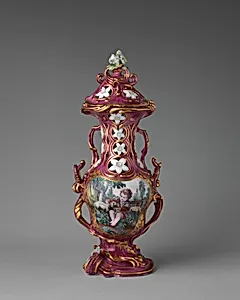
Vase (one of a set of three)
ca. 1761
Medium
Soft-paste porcelain
Dimensions
Height: 12 9/16 in. (31.9 cm)
Classification
Ceramics-Porcelain
Culture
British, Chelsea
Department
European Sculpture and Decorative Arts
Museum
Metropolitan Museum of Art, New York, NY
Credit
Gift of Irwin Untermyer, 1971
Accession Number
1971.75.25a, b
Rights
Public Domain
Tags
Art Historical Context
This elegant vase, one of a set of three produced by the renowned Chelsea Porcelain Manuf around 1761, exemplifies the pinnacle of mid-18th-century British ceramic artistry. Standing at 12 9/16 inches tall, it is crafted from soft-paste porcelain—a innovation blending clay with ground glass and fired at lower temperatures than true Chinese hard-paste. Chelsea, London's pioneering porcelain factory founded in the 1740s, mastered this medium to rival imported luxuries, often adorning pieces with vibrant enamels, gilding, and intricate modeling. The vase's surface bursts with playful motifs of boys and goats frolicking amid blooming flowers, capturing the whimsical, naturalistic spirit of the Rococo style then sweeping European decorative arts. These figural scenes, likely raised or painted in rich colors, reflect Chelsea's expertise in combining sculptural relief with painterly detail, making such vases prized centerpieces for aristocratic tables or mantels. A gift to the Metropolitan Museum of Art from Irwin Untermyer in 1971, this piece highlights Chelsea's brief but brilliant legacy—producing opulent wares until 1769—before British porcelain shifted toward bone china. It invites us to appreciate how 18th-century artisans transformed everyday vessels into storytelling treasures of joy and abundance.
About the Artist
Chelsea Porcelain Manufactory · 1744–1784
**Chelsea Porcelain Manufactory** The Chelsea Porcelain Manufactory, Britain's pioneering porcelain enterprise, was founded around 1743 in Chelsea, London, by two Huguenot silversmiths: Nicholas Sprimont from Liège and Charles Gouyn. Sprimont, trained in Paris as a goldsmith before immigrating to England, brought his expertise in luxury metalwork to the venture, while Gouyn handled early sales th...