
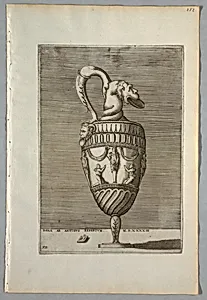
Vase (Plate 12 of a Series)
Medium
ornament
Classification
ornament
Department
Smithsonian Collection
Museum
Smithsonian American Art Museum
Credit
Museum purchase through gift of E.F. Caldwell & Co.
Accession Number
1963-9-251
Rights
Public Domain
About this artwork
Research in Progress
Art Historical Context
Enea Vico, a prolific Italian engraver active during the Renaissance (1523–1567), created this intricate *Vase (Plate 12 of a Series)* in1543. Working primarily in Rome and Verona,ico was renowned for his prints of classical-inspired ornaments, drawing from ancient Roman motifs rediscovered during the era's humanist revival. These designs bridged fine art and applied crafts, influencing goldsmiths, silversmiths, and across Europe. As plate 12 from a larger series, this work exemplifies Vico's mastery of engraving, a medium that allowed precise reproduction of elaborate vase forms adorned with scrolling acanthus leaves, mythical creatures, and geometric patterns. Such ornamental prints were not mere decoration but practical pattern books, disseminating Renaissance ideals of harmony and proportion. Vico's style reflects Mannerist tendencies—elegant yet complex—helping popularize "grotesque" motifs from sites like the Domus Aurea. Housed in the Smithsonian American Art Museum's Smithsonian Collection (museum purchase through the gift of E.F. Caldwell & Co.), this piece highlights the enduring appeal of Renaissance design. Ongoing research promises deeper insights into its production and impact.