
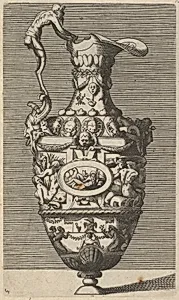
Vase with a River God in an Oval Medallion
17th century (late)
Medium
Engraving
Dimensions
Plate: 7 1/2 x 4 7/16 in. (19 x 11.2 cm)
Classification
Prints|Ornament & Architecture
Department
Drawings and Prints
Museum
Metropolitan Museum of Art, New York, NY
Credit
Bequest of Phyllis Massar, 2011
Accession Number
2012.136.952(5)
Rights
Public Domain
Tags
Art Historical Context
Nestled within the intricate world of 17th-century ornamental prints *Vase with a River in an Oval Medallion showcases a fantastical design attributed to a collaboration of talents including Dutch engravers Frederick de Wit and Claes Jans. Visscher, influences from Italian Mannerist Rossoentino and French engraver Boyvin. Created in the late 1600s, this small engraving (7 1/2 x 4 7/16 inches) captures a classical vase adorned with a muscular river god framed in an elegant oval medallion, evoking the mythological rivers of antiquity that symbolized fertility and flow. As a prime example of Prints in the Ornament & Architecture classification, this work reflects the era's booming market for pattern books. Engraving, with its precise burin lines, allowed artists to reproduce elaborate motifs for silversmiths, ceramists, and architects across Europe. These designs bridged Renaissance humanism and emerging Baroque exuberance, turning ancient gods into decorative inspirations for vases and vessels. Today, housed in the Metropolitan Museum of Art's Drawings and Prints department through the generous bequest of Phyllis Massar in 2011, this piece invites visitors to appreciate how printed imagery democratized luxury design, blending myth with craftsmanship in a timeless decorative language.
About the Artist
Frederick de Wit|Rosso Fiorentino|René Boyvin|Claes Jansz. Visscher (Netherlandish|Dutch) · 1571 |1629 –1656 |1706
Netherlandish, Antwerp 1571–1656 Rotterdam|Dutch, 1629/30–1706