
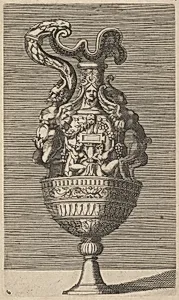
Vase with Two Winged Satyrs
Medium
Engraving
Dimensions
Plate: 7 1/2 x 4 7/16 in. (19 x 11.2 cm)
Classification
Prints|Ornament & Architecture
Department
Drawings and Prints
Museum
Metropolitan Museum of Art, New York, NY
Credit
Bequest of Phyllis Massar, 2011
Accession Number
2012.136.952(9)
Rights
Public Domain
Tags
Art Historical Context
Behold the *Vase with Two Wing Satyrs*, a captivating late 17th-century (7 1/2 x 4 7/16 in.) from the Metropolitan Museum of Art's Drawings and Prints department. This intricate print, credited to publishers and engravers like Frederick de and Claes Jansz Visscher, draws on designs possibly inspired by Renaissance masters such as Rosso Fior and Polidoro da Caravaggio. These earlier Mannerist artists were renowned for their whimsical grotesques—fantastical motifs blending human, animal, and mythical forms—that influenced decorative arts across Europe. Engraving, as the medium here, was revolutionary for its precision and reproducibility, allowing ornate designs like this vase flanked by playful winged satyrs to circulate widely among artists, architects, and craftsmen. Ornament and architecture prints like this one served as pattern books, fueling the Baroque era's love for exuberant, mythological embellishments on furniture, ceramics, and facades. Satyrs, those merry half-man, half-goat figures from classical antiquity, evoke Dionysian revelry and Renaissance revival of ancient motifs. Generously bequeathed by Phyllis Massar in 2011, this work exemplifies how prints bridged centuries, preserving innovative ideas in an accessible format. A delightful window into 17th-century design culture!
About the Artist
Frederick de Wit|Rosso Fiorentino|Polidoro da Caravaggio|Claes Jansz. Visscher|René Boyvin (Netherlandish|Dutch) · 1571 |1629 –1656 |1706
Netherlandish, Antwerp 1571–1656 Rotterdam|Dutch, 1629/30–1706