
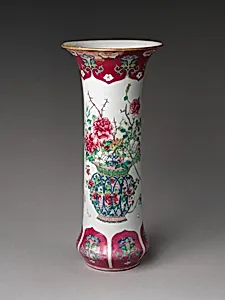
Vase with Basket of Auspicious Flowers
Unknown Artist
18th century
Medium
Porcelain painted with colored enamels over transparent glaze (Jingdezhen ware)
Dimensions
H. 18 3/4 in. (47.6 cm)
Classification
Ceramics
Culture & Period
China · Qing dynasty (1644–1911), Qianlong period (1736–95)
Department
Asian Art
Museum
Metropolitan Museum of Art, New York, NY
Credit
Bequest of Benjamin Altman, 1913
Accession Number
14.40.197
Rights
Public Domain
Tags
Art Historical Context
This elegant porcelain vase, titled *Vase with Basket ofpicious Flowers*, hails from China's Qing dynasty during the Qianlong period (173695), a golden era of imperial artistry under Emperor Qianlong. Standing at 18 3/4 inches tall, it exemplifies the pinnacle of Jingdezhen ware—the renowned imperial kilns in Jiangxi province that produced the world's finest porcelain for over six centuries. Crafted in the 18th century, such vases were often commissioned for palaces or as diplomatic gifts, symbolizing the dynasty's wealth, technical mastery, and cultural refinement. The vase features a delicate basket overflowing with vibrant flowers, painted in colored enamels over a transparent glaze—a sophisticated technique known as *yangcai* or famille rose. This overglaze enameling allowed for soft, luminous hues of pink, green, and gold that fired at lower temperatures, enabling intricate details impossible in traditional blue-and-white underglaze. In Chinese culture, these "auspicious flowers"—likely including peonies for prosperity, lotuses for purity, and prunus blossoms for endurance—carried deep symbolic meaning, invoking good fortune, longevity, and harmony for the owner. Now part of the Metropolitan Museum of Art's Asian Art collection, thanks to the 1913 bequest of Benjamin Altman, this anonymous masterpiece invites us to marvel at Qing porcelain's enduring allure, blending artistry with auspicious wishes.