
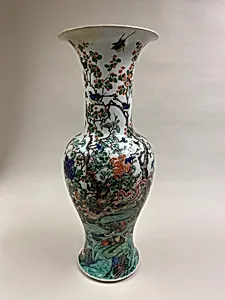
Vase with birds and flowers
Unknown Artist
late 17th–early 18th century
Medium
Porcelain painted in overglaze polychrome enamels (Jingdezhen ware)
Dimensions
H. 27 3/4 in. (70.5 cm); Diam. 11 in. (27.9 cm)
Classification
Ceramics
Culture & Period
China · Qing dynasty (1644–1911), Kangxi period (1662–1722)
Department
Asian Art
Museum
Metropolitan Museum of Art, New York, NY
Credit
Bequest of Edmund C. Converse, 1921
Accession Number
21.175.1
Rights
Public Domain
Tags
Art Historical Context
This elegant vase, standing nearly 28 inches tall, exemplifies the pinnacle of Chinese porcelain artistry from the Kangxi period (1662–1722) of the Qing dynasty. Produced at Jingdezhen, the unrivaled center of porcelain manufacturing in China, it features delicate overglaze polychrome enamels—vibrant colors applied after the initial glazing and fired at lower temperatures to preserve their luminosity. This technique allowed artisans to create lifelike depictions of birds amid blooming flowers, motifs that evoke nature's harmony and abundance. During the Kangxi era, imperial kilns at Jingdezhen innovated extensively, blending technical mastery with aesthetic refinement to supply both the court and export markets. Such vases were prized for their baluster shape and intricate designs, symbolizing prosperity and longevity in Chinese culture. The overglaze enamels, in shades of blue, green, yellow, and rose, highlight the period's experimentation with famille verte and other palettes, marking a high point in ceramic export wares that influenced global tastes. Today, this treasure from the Metropolitan Museum of Art's Asian Art collection, bequeathed by Edmund C. Converse in 1921, invites visitors to appreciate the Qing dynasty's enduring legacy of beauty and craftsmanship.