
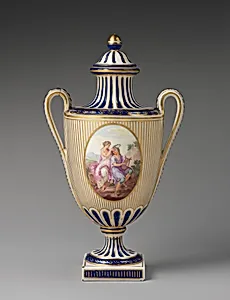
Vase with cover
Medium
Soft-paste porcelain
Dimensions
Height: 10 3/8 in. (26.4 cm)
Classification
Ceramics-Porcelain
Culture
British, Chelsea-Derby
Department
European Sculpture and Decorative Arts
Museum
Metropolitan Museum of Art, New York, NY
Credit
Bequest of John L. Cadwalader, 1914
Accession Number
14.58.68a, b
Rights
Public Domain
Tags
Art Historical Context
This elegant "Vase with Cover," produced around 1775 by the Derby Porcelain Manufactory in collaboration with artists Zachariah Boreman, Askew, and Angelicaauffmann, exemplifies the of British Chelsea-Derby porcelain. Standing at 10 3/8 inches tall, it was crafted from soft-paste porcelain—a refined, creamy material blending clay, glass frit, and bone ash that allowed English makers to rival continental giants like Meissen and Sèvres. The Chelsea-Derby period (post-1770 merger) marked a golden era for British ceramics, blending technical innovation with neoclassical elegance for the elite market. The vase's decoration, featuring lyres alongside graceful men and women, reflects the era's fascination with classical antiquity, likely inspired by Kauffmann's renowned history paintings. These motifs—painted and modeled with exquisite detail—highlight the manufactory's prowess in combining molded forms with vibrant enameling techniques. Enamels were fired at lower temperatures to add rich colors without distorting the delicate paste, creating a luminous finish prized by 18th-century collectors. Bequeathed to the Metropolitan Museum of Art in 1914 by John L. Cadwalader, this piece offers a window into Georgian luxury, where porcelain wasn't just functional but a canvas for artistic storytelling. Visitors will appreciate its harmonious blend of form, function, and fantasy.
About the Artist
Derby Porcelain Manufactory|Zachariah Boreman|Robert Askew|Angelica Kauffmann · 1751–1785
The Derby Porcelain Manufactory stands as one of the foundational institutions of British ceramic art, producing some of the finest figures and tablewares made in England during the eighteenth and early nineteenth centuries. Its origins can be traced to the work of André Planché, a Huguenot immigrant from Saxony who settled in Derby around 1745 and began producing soft-paste porcelain figures and ...