
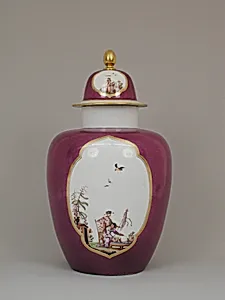
Vase with cover
ca. 1730
Medium
Hard-paste porcelain
Dimensions
Height (with cover): 20 in. (50.8 cm)
Classification
Ceramics-Porcelain
Culture
German, Meissen
Department
European Sculpture and Decorative Arts
Museum
Metropolitan Museum of Art, New York, NY
Credit
Bequest of Alfred Duane Pell, 1924
Accession Number
38.166.1a, b
Rights
Public Domain
Tags
Art Historical Context
This elegant vase with cover from the Me Manufactory, dating to around 1730, exemplifies the dawn of Europe's porcelain revolution. Founded in 1710 under the patronage of Augustus the Strong, Elector of Saxony, Meissen was first European factory to produce true hard-paste porcelain—a durable, translucent material long monopolized by China. Standing 20 inches tall, this piece was a luxury object for tables or displays, showcasing the technical mastery that made Meissen synonymous with opulence during the early Rococo era. Adorned in the popular chinoiserie style, the vase features whimsical European interpretations of Chinese scenes, populated by men, women, children, and birds amid lush, fantastical landscapes. Artisans employed intricate techniques like overglaze enameling for vibrant colors and gold accents for a shimmering finish, hand-painted with meticulous detail that highlights Meissen's unrivaled skill. These motifs reflected Europe's 18th-century fascination with the exotic East, blending cultural admiration with imaginative flair. Bequeathed to the Metropolitan Museum of Art in 1924 by Alfred Duane Pell, this vase captures a pivotal moment when German craftsmanship rivaled Asian imports, influencing decorative arts across the continent. A true gem of European ceramics!
About the Artist
Meissen Manufactory · 1710–present
The Meissen Manufactory, established on June 6, 1710, by Augustus the Strong, Elector of Saxony and King of Poland, marked the dawn of true hard-paste porcelain production in Europe. Nestled at Albrechtsburg Castle in Meissen near Dresden, the Royal Polish and Electoral Saxon Porcelain Manufactory arose from alchemical experiments begun in 1708 by physicist Ehrenfried Walther von Tschirnhaus and p...