
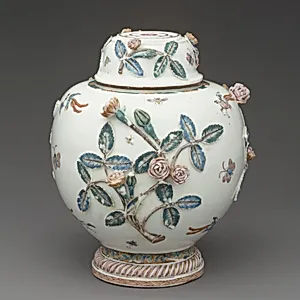
Vase with cover
ca. 1715, decorated ca. 1725–30
Medium
Hard-paste porcelain
Dimensions
Height: 6 in. (15.2 cm)
Classification
Ceramics-Porcelain
Culture
German, Meissen with Dutch decoration
Department
European Sculpture and Decorative Arts
Museum
Metropolitan Museum of Art, New York, NY
Credit
Gift of R. Thornton Wilson, in memory of Florence Ellsworth Wilson, 1950
Accession Number
50.211.239a, b
Rights
Public Domain
Tags
Art Historical Context
Step into the elegant world of early 18th-century European with this charming *Vase with Cover* the Meissen Manuf during the Böttger Period Created around 1715 and adorned with delicate floral decoration circa 1725–30, this petite hard-paste porcelain vessel stands just 6 inches (15.2 cm) tall. Meissen, founded in Germany under the patronage of Augustus the Strong, Elector of Saxony, achieved a revolutionary breakthrough with hard-paste porcelain—the first true European equivalent to coveted Chinese wares. Johann Friedrich Böttger, the alchemist-turned-ceramicist who unlocked its secret formula in 1708–10, marked the dawn of this Böttger era, transforming Saxony into Europe's porcelain powerhouse. The vase's body exemplifies Meissen's early technical mastery: durable, translucent hard-paste fired at high temperatures, allowing for fine shapes and intricate details. Its later Dutch decoration—vibrant flowers hand-painted in overglaze enamels—reflects a common 18th-century practice of exporting blank pieces to skilled Dutch artists for finishing, blending German innovation with Netherlandish flair. These floral motifs evoke the opulent Rococo tastes emerging in aristocratic homes, where such vases symbolized wealth and refined taste. Today, this gift to the Metropolitan Museum of Art in 1950 invites us to appreciate how Meissen's ingenuity democratized luxury, bridging Eastern traditions with Western artistry and fueling a porcelain mania across Europe.
About the Artist
Meissen Manufactory|Böttger Period · 1710–present
The Meissen Manufactory, established on June 6, 1710, by Augustus the Strong, Elector of Saxony and King of Poland, marked the dawn of true hard-paste porcelain production in Europe. Nestled at Albrechtsburg Castle in Meissen near Dresden, the Royal Polish and Electoral Saxon Porcelain Manufactory arose from alchemical experiments begun in 1708 by physicist Ehrenfried Walther von Tschirnhaus and p...