
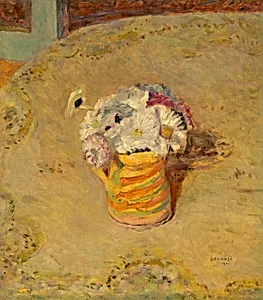
Vase with Flowers
1920
Medium
oil on canvas
Dimensions
overall: 43.18 × 38.1 cm (17 × 15 in.) framed: 52.07 × 46.67 × 3.81 cm (20 1/2 × 18 3/8 × 1 1/2 in.)
Classification
Painting
Department
CMC
Museum
National Gallery of Art, Washington, D.C.
Credit
Collection of Mr. and Mrs. Paul Mellon
Accession Number
2014.18.2
Rights
Public Domain
Art Historical Context
Pierre Bonnard's *Vase with Flowers*1920), an intimate oil on canvas measuring just 17 × 15 inches, captures the artist's lifelong fascination with domestic still lifes. Painted in the serene aftermath of World War I, this work reflects Bonnard's retreat to his sun-drenched home in the south of France, where he immersed himself in the simple joys of everyday objects. The small scale invites viewers close, much like peering into a personal vignette from his life. As a key figure in the Post-Impressionist group Les Nabis, Bonnard revolutionized still-life painting with his luminous color palette and fluid brushwork. He applied paint in loose, dappled strokes, blending patterns of light and shadow to evoke a sense of fleeting beauty and emotional warmth. Flowers, a recurring motif, symbolize vitality and transience, rendered here with vibrant hues that dance across the canvas, blurring the boundaries between object and atmosphere. Now housed in the National Gallery of Art as part of the distinguished Collection of Mr. and Mrs. Paul Mellon, this piece exemplifies Bonnard's enduring influence on modern art, bridging Impressionism's light effects with intimate modernism. It's a gentle reminder of art's power to infuse the ordinary with poetry.
About the Artist
Pierre Bonnard · 1867–1947
Pierre Bonnard (1867–1947) was a French painter and printmaker who became a leading figure in the Post-Impressionist movement and a founding member of Les Nabis. Born on October 3, 1867, in Fontenay-aux-Roses, France, Bonnard initially studied law at his father's insistence, graduating and briefly practicing as a barrister in 1888. However, his true passion lay in art, and he had simultaneously at...