
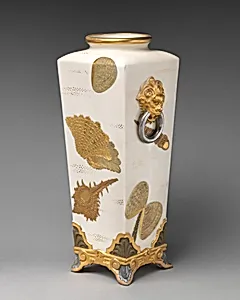
Vase with gold sea shell motifs
Medium
Porcelain
Dimensions
confirmed: 11 1/8 in. × 5 1/16 in. × 10 ft. (28.3 × 12.9 × 304.8 cm)
Classification
Ceramics-Porcelain
Culture
British, Worcester
Department
European Sculpture and Decorative Arts
Museum
Metropolitan Museum of Art, New York, NY
Credit
Gift of Helene Fortunoff and Robert Grossman, 2017
Accession Number
2018.62.102
Rights
Public Domain
Art Historical Context
This elegant porcelain vase, titled *Vase with Gold Sea Motifs*, hails from the renowned Worcester factory in Britain, crafted in 1878 during the height of the Victorian era. by one of England's leading porcelain manufacturers—established in 1751 famed for its bone china—the piece exemplifies the opulence of 19th-century decorative arts Measuring an imposing 11⅛ × 5¹⁄₁₆ inches × 10 feet (28.3 × 12.9 × 304.8 cm), its substantial scale suggests it was designed as a grand statement piece for lavish interiors, perhaps a mantel or pedestal ornament. The vase's standout feature is its intricate gold sea shell motifs, achieved through skilled gilding techniques where liquid gold was applied, fired, and burnished to a luminous sheen—a hallmark of Worcester's technical mastery and luxury appeal. Sea shell designs evoked the Romantic fascination with nature and the sea, blending naturalism with exotic allure popular among the British elite. Porcelain's translucency and durability made it ideal for such elaborate decorations, elevating everyday vessels to sculptural art. Now housed in the Metropolitan Museum of Art's Department of European Sculpture and Decorative Arts as a 2017 gift from Helene Fortunoff and Robert Grossman, this vase offers a window into Britain's industrial porcelain legacy, where artistry met innovation to adorn the homes of the Victorian aristocracy.
About the Artist
Worcester factory · 1751–2008
The Worcester porcelain factory, established in 1751 in Worcester, England, by physician Dr. John Wall and apothecary William Davis along with 14 partners, marked the birth of one of Britain's most enduring ceramic enterprises. Investing £4,500 at Warmstry House on the River Severn, the founders drew on contacts with the Bristol porcelain manufactory to develop a novel soft-paste porcelain using s...