
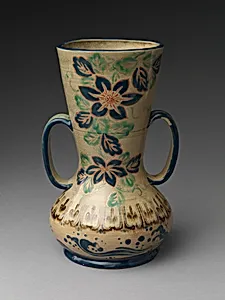
Vase with handles
Unknown Artist
18th century
Medium
Stoneware with polychrome enamels (Ko-Kiyomizu ware)
Dimensions
H. 9 3/4 in. (24.8 cm)
Classification
Ceramics
Culture & Period
Japan · Edo period (1615–1868)
Department
Asian Art
Museum
Metropolitan Museum of Art, New York, NY
Credit
Gift of Florence and Herbert Irving, 2015
Accession Number
2015.500.9.34
Rights
Public Domain
Tags
Art Historical Context
This elegant "Vase with Handles" from 18th-century Japan exemplifies the refined artistry of the Edo period (1615–1868), a time of peace and cultural flourishing when ceramics became prized for both everyday use and display. Crafted in stoneware with vibrant polychrome enamels characteristic of Ko-Kiyomizu ware—a Kyoto style developed in the late 17th century—this piece stands at 9 3/4 inches tall. Its delicate form, adorned with motifs of flowers and leaves, reflects the Japanese aesthetic of natural harmony and seasonal beauty, often evoking cherry blossoms or foliage in full bloom. Ko-Kiyomizu ware is renowned for its innovative overglaze enameling technique, where colorful enamels are applied atop a glazed stoneware body and fired at lower temperatures to achieve vivid hues of red, green, and gold without fading. This method allowed potters to create intricate, painterly designs on functional objects, bridging painting and ceramics. Though the artist remains unknown, such vases were likely produced in Kyoto workshops, serving as ornamental centerpieces in homes, tea rooms, or on household altars. Today, this vase graces the Metropolitan Museum of Art's Asian Art Department, a generous gift from Florence and Herbert Irving in 2015. It offers a window into Edo Japan's sophisticated craft traditions, where everyday items doubled as expressions of poetic elegance and technical mastery.