
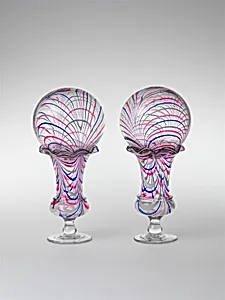
Vase with witch ball
1850–75
Medium
Free-blown colorless, red, white and blue glass
Dimensions
H. 13 1/2 in. (34.3 cm); Diam. 6 1/2 in. (16.5 cm)
Classification
Vase
Culture
American
Department
The American Wing
Museum
Metropolitan Museum of Art, New York, NY
Credit
Purchase, The Edgar J. Kaufmann Foundation Gift, 1969
Accession Number
69.84.2a, b
Rights
Public Domain
Art Historical Context
This elegant vase with witch ball, crafted by the New England Glass Company between 1850 and 1875, exemplifies mid-19th-century Americanmaking prowess. Standing 13½ inches tall with a 6½-inch diameter, it features-blown glass in striking colorless, red, white and blue tones—patriotic hues that evoke national pride during the post-C War era. The New England Glass Company, based in Cambridge, Massachusetts, was a leading innovator, producing both utilitarian and decorative wares that rivaled European imports. At its core is a shimmering witch ball, a hollow glass sphere traditionally hung in homes to ward off evil spirits, witches, or ill fortune by trapping them inside its reflective surface. This piece merges the orb's folkloric charm with a functional vase form, highlighting the era's blend of superstition and ornamentation. Free-blowing, the technique used here, involved gathering molten glass on a blowpipe and shaping it by lung power and tools, allowing for fluid, organic contours without molds. Housed in The Metropolitan Museum of Art's American Wing, this vase (acquired through the Edgar J. Kaufmann Foundation Gift in 1969) reflects America's growing glass industry and cultural fascination with protective talismans. It invites visitors to ponder how everyday beauty intertwined with Victorian beliefs in the supernatural.
About the Artist
New England Glass Company · 1818–1888
**The New England Glass Company: Pioneers of American Flint Glass** The New England Glass Company was established on February 16, 1818, in East Cambridge, Massachusetts, by a quartet of prominent local businessmen: Amos Binney, Edmund Munroe, Daniel Hastings, and Deming Jarves. Jarves, drawing on his dry goods background and talent for recruiting Europe's finest cutters, served as operational man...