
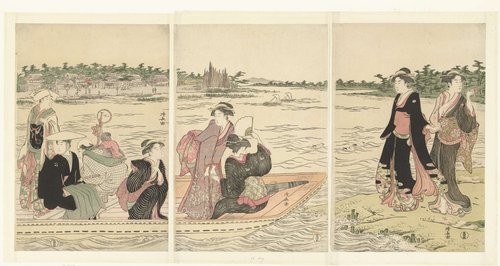
Veerboot op de rivier de Sumida
1785 - 1789
Medium
color woodcut
Dimensions
382; 382; 259; 384; 260; 258
Rights
Public Domain
About this artwork
kleurenhoutsnede; lijnblok in zwart met kleurblokken
Art Historical Context
Torii Kiyonaga's *Veerboot op de rivier Sumida* (Ferryboat on the Sum River), created between 1785 and1789, captures a serene moment on one of Edo's (modern-day Tokyo's) most vital waterways. As a master of ukiyo-e—the "pictures of the floating world"—Kiyonaga specialized in depicting everyday life, beautiful women, and urban scenes with graceful elegance. This color woodcut portrays passengers aboard a ferry, evoking the bustling rhythm of 18th-century Japan, where the Sumida River served as a lifeline for trade, travel, and leisure. The print exemplifies the sophisticated woodblock printing technique of the Edo period: a key black line block provides precise contours, overlaid with multiple color blocks for vibrant hues and subtle gradations. Measuring 382 mm high by 258 mm wide, its intimate scale made it accessible to a wide audience, from merchants to samurai. Kiyonaga's style stands out for elongated figures, flowing kimonos, and atmospheric depth, bridging the Kamigata and Edo schools of ukiyo-e. Culturally, such prints democratized art, reflecting Japan's urban sophistication amid isolationist policies. This work highlights the river's role in social life, offering visitors a window into a vibrant era where art mirrored fleeting pleasures.
About the Artist
Torii Kiyonaga · 1752–1815
Torii Kiyonaga, born Sekiguchi Shinsuke in 1752 in Uraga, Sagami Province, was the son of an Edo bookseller who owned tenements near a bustling fish market. At age 14 in 1765, he began his apprenticeship under Torii Kiyomitsu, the third-generation head of the prestigious Torii school of ukiyo-e, renowned for kabuki theater illustrations and signage. Adopted into the Torii family, Kiyonaga succeede...