
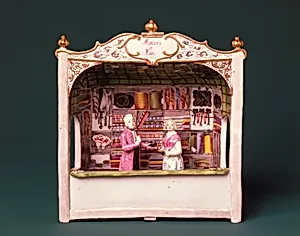
"Venetian Fair" shop with two figures
Medium
Hard-paste porcelain
Dimensions
Overall (shop .226): 6 × 5 1/2 × 2 1/8 in. (15.2 × 14 × 5.4 cm); Height (man .227): 2 3/4 in. (7 cm); Height (woman .228): 2 1/2 in. (6.4 cm)
Classification
Ceramics-Porcelain
Culture
German, Ludwigsburg
Department
European Sculpture and Decorative Arts
Museum
Metropolitan Museum of Art, New York, NY
Credit
Gift of R. Thornton Wilson, in memory of Florence Ellsworth Wilson, 1950
Accession Number
50.211.226–.228
Rights
Public Domain
Tags
Art Historical Context
This charming hard-paste porcelain ensemble, created around 1765 by the Ludwigsburg Porcelain Manufactory in Germany, captures the lively spirit of an 18th-century market stall. The miniature “Venetian Fair” shop, accompanied by a male merchant and female companion, showcases the factory’s mastery of delicate modeling and vibrant overglaze painting. Every fold of textile and tiny accessory is rendered with precision, reflecting the Rococo taste for playful, theatrical scenes that brought elegance to aristocratic dining tables and cabinets. Ludwigsburg, founded in 1758 under Duke Carl Eugen of Württemberg, was one of several German porcelain factories competing to rival Meissen and the fabled productions of China. Hard-paste porcelain, achieved through the secret combination of kaolin and petuntse, allowed for the fine detail and luminous surfaces seen here. Such fairground vignettes were popular because they evoked the excitement of Venice’s carnival and international trade, transporting viewers to a world of exotic goods and social spectacle. Today in the Metropolitan Museum’s collection, the group offers a delightful glimpse into Enlightenment-era leisure and the technical brilliance of European porcelain. Its small scale—barely six inches wide—belies the extraordinary craftsmanship that made these figures treasured conversation pieces in their own time.