
Venice
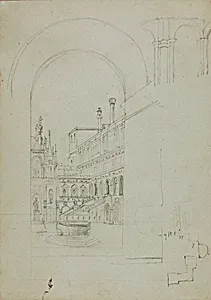
Medium
Drawing
Classification
Drawing
Department
Smithsonian Collection
Museum
Smithsonian American Art Museum
Credit
Smithsonian American Art Museum, Bequest of Martha F. Butler
Accession Number
1991.56.92
Rights
Public Domain
Tags
Art Historical Context
Nestled within the Smithsonian American Art Museum's collection *Venice* is a drawing by Miner Kilbourne Kellogg, an American artist active in the 19th. Though the exact date remains unknown, this work likely stems from Kellogg's travels across Europe, where he immersed himself in the continent's rich artistic heritage. The piece depicts a quintessential Venetian square, featuring a graceful arch and a historic well—elements that evoke the city's labyrinthine piazzas, bustling with daily life amid Renaissance architecture. Kellogg, known for his neoclassical portraits and landscapes, favored precise, evocative sketches like this one, which capture the atmospheric charm of Venice. As a drawing, it highlights the medium's intimacy: quick lines and subtle shading allowed artists like Kellogg to study light, shadow, and texture on-site, serving as both personal mementos and inspirations for larger paintings. Venice, a muse for countless artists from Turner to Sargent, symbolized romantic decay and exotic allure in the 19th century, reflecting America's growing fascination with European grandeur. Bequeathed by Martha F. Butler, this artwork offers visitors a window into Kellogg's wanderlust and the enduring allure of La Serenissima. Its inclusion in the Smithsonian underscores the value of such modest drawings in preserving cultural snapshots of a timeless city.