
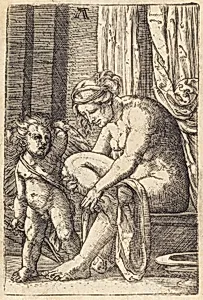
Venus after the Bath
c. 1525/1530
Medium
engraving
Classification
Department
CG-E
Museum
National Gallery of Art, Washington, D.C.
Credit
Rosenwald Collection
Accession Number
1943.3.405
Rights
Public Domain
Art Historical Context
Albrecht Altdorfer's *Venus after the Bath*, around 1525–1530, is a delicate engraving that captures the nude goddess of love in a moment of intimate repose. As a leading figure of the Danube School in the Northern Renaissance, Altdorfer meticulous detail with a poetic sense of nature, often elevating landscape elements to near-mythic status. Here, Venus emerges from her bath, her form rendered with soft, flowing lines that evoke both classical antiquity and the era's fascination with the human body. This print exemplifies the technical virtuosity of early 16th-century engraving, a medium Altdorfer mastered to produce intricate textures—from the subtle sheen of damp skin to intricate folds of drapery. Engravings like this were revolutionary, allowing artists to disseminate their visions widely and affordably, influencing collectors across Europe. The subject draws from Venetian inspirations like Titian, yet Altdorfer infuses it with his signature atmospheric depth, merging sensuality with a northern restraint. Housed in the National Gallery of Art's Rosenwald Collection (Department CG-E), this work highlights the Renaissance revival of pagan mythology amid religious upheavals, offering visitors a glimpse into how beauty and divinity were reimagined in miniature form.
About the Artist
Albrecht Altdorfer · 1475–1538
Albrecht Altdorfer (c. 1480–1538) was a German painter, printmaker, and draftsman who stands as one of the founders of landscape painting as an independent genre. Born in Regensburg or nearby Altdorf, he learned art from his father Ulrich, a painter and miniaturist. Altdorfer spent most of his life in Regensburg, becoming a citizen in 1505 and later serving as the city's official architect and a m...