
Venus Anadyomene
c. 1841/1842
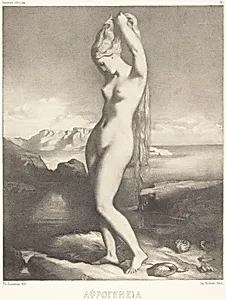
Medium
lithograph on gray-tinted chine colle
Classification
Department
CG-E
Museum
National Gallery of Art, Washington, D.C.
Credit
Rosenwald Collection
Accession Number
1943.3.2784
Rights
Public Domain
Art Historical Context
In the National Gallery of Art's Rosen Collection, *Venus Anadyomene* (c. 1841/1842) by Thé Chassériau captures the mythical birth of Venus rising from the sea, a motif inspired by ancient Greek sculptures and paintings, such as the lost work by Apelles. Created when Chassériau was in his early twenties, this lithograph reflects the young French artist's burgeoning talent, blending the precise line work of his mentor Ingres with the sensual romanticism influenced by Delacroix. As a print in the CG-E department, it exemplifies 19th-century Romanticism's fascination with idealized beauty and mythology, making high art accessible beyond oil paintings. The medium—lithograph on gray-tinted chine collé—is particularly noteworthy. Lithography, a planar printing process invented around 1796, allowed artists like Chassériau to achieve fluid, painterly effects with crayon on stone, ideal for evoking the goddess's soft contours and flowing hair. Chine collé, where delicate Asian paper is glued to a stronger support, enhanced the subtle tonalities and preserved the print's fragility, a technique popular among Romantic printmakers for its elegance and reproducibility. This early work highlights Chassériau's versatility before his fame in murals and Orientalist scenes, offering visitors a glimpse into how prints democratized artistic vision in mid-19th-century France.
About the Artist
Théodore Chassériau · 1819–1856
Théodore Chassériau was born on September 20, 1819, in El Limón, Samaná, in the Spanish colony of Santo Domingo — present-day Dominican Republic — to a French father and a Creole mother. The family relocated to Paris in 1820, and the young Chassériau's exceptional talent was evident almost immediately. At just eleven years old, in 1830, he was accepted into the prestigious studio of Jean-Auguste-D...