
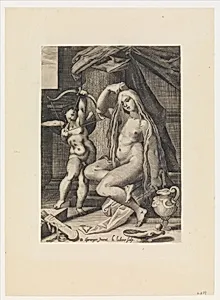
Venus and Cupid
1571–1650
Medium
Engraving
Dimensions
H. 7-3/8 x W. 5-3/16 in. (18.7 x 13.3 cm.)
Classification
Prints
Department
Robert Lehman Collection
Museum
Metropolitan Museum of Art, New York, NY
Credit
Robert Lehman Collection, 1975
Accession Number
1975.1.845
Rights
Public Domain
Tags
Art Historical Context
**Venus and Cupid** is a delicate engraving by Bartholomeus Spranger, a leading Flemish Mannerist artist active in the late 16th century. Created during Spranger's career (ca. 1571–1650), this print exemplifies the elegant, elongated figures and sensual grace characteristic of Mannerism—a style that bridged the High Renaissance and Baroque, emphasizing artificial poses and refined beauty over naturalism. Spranger, who served at the imperial court in Prague under Rudolf II, often depicted mythological themes with a playful eroticism, making his works highly prized among collectors. The image features the Roman goddess Venus, nude and radiant, accompanied by her son Cupid, capturing a tender yet intimate moment of divine love. Measuring just 7-3/8 x 5-3/16 inches, the engraving's small scale belies its technical mastery: fine lines incised into a metal plate allow for intricate details, subtle shading, and a luminous quality that mimics painting. As a print medium, it democratized access to elite art, enabling widespread dissemination of Spranger's sophisticated designs. Housed in the Metropolitan Museum of Art's Robert Lehman Collection since 1975, this piece highlights the cultural fascination with classical mythology and the nude in Renaissance Europe, inviting visitors to appreciate the interplay of mythology, sensuality, and virtuoso printmaking.