
Cleopatra
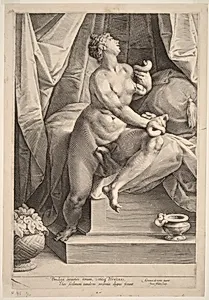
Medium
engraving on laid paper
Dimensions
plate: 38.3 x 25.5 cm (15 1/16 x 10 1/16 in.) sheet: 40.6 x 28 cm (16 x 11 in.)
Classification
Department
CG-E
Museum
National Gallery of Art, Washington, D.C.
Credit
Gift of Ruth Cole Kainen
Accession Number
2012.92.576
Rights
Public Domain
Art Historical Context
This engraving of Cleopatra, created around 1598 by Jan Muller after a design by the sculptor Adriaen de Vries, captures the legendary Egyptian queen in a moment of quiet drama. Muller, a skilled Dutch printmaker, translated de Vries’s sculptural vision into a detailed engraving on laid paper. The medium allowed the image to reach a wide audience beyond those who could view the original sculpture, a common practice in the late Renaissance when prints helped spread artistic ideas across Europe. Measuring roughly 38 by 25 centimeters in the plate, the work reflects the elegant, elongated forms typical of Mannerist art, which favored graceful poses and classical themes drawn from antiquity. Cleopatra’s story—her intelligence, power, and tragic fate—made her a popular subject for artists exploring themes of beauty and downfall. As a print, this engraving highlights the technical precision of the burin, where fine lines create texture and depth on the paper’s subtle laid surface. Housed in the National Gallery of Art as a gift from Ruth Cole Kainen, the piece offers modern viewers a window into how 16th-century artists blended sculpture and printmaking to celebrate timeless stories.
About the Artist
Jan Muller, after Adriaen de Vries
**Jan Harmensz. Muller (1571–1628)** was a Dutch engraver, draughtsman, and painter renowned for his masterful reproductive prints after leading Northern Mannerist sculptors and painters, particularly Adriaen de Vries. Born in Amsterdam and baptized on 1 July 1571, Muller came from a family deeply involved in the print trade; his father, Harmen Jansz. Muller, was a book printer, engraver, and publ...