
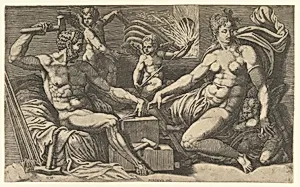
Venus and Vulcan at the Forge
Medium
Engraving
Dimensions
sheet: 7 1/2 x 12 3/16 in. (19 x 31 cm) trimmed to borderline
Classification
Prints
Department
Drawings and Prints
Museum
Metropolitan Museum of Art, New York, NY
Credit
The Elisha Whittelsey Collection, The Elisha Whittelsey Fund, 1949
Accession Number
49.95.3
Rights
Public Domain
Tags
Art Historical Context
This engraving captures the mythological encounter between Venus, the goddess of love, her husband Vulcan at his forge, a scene rich with themes of divine craftsmanship and affection. Created around 1555, the work reflects a collaboration between designer Perino del Vaga a leading Mannerist artist trained in Raphael’s circle, and engraver Giorgioisi, renowned for translating painted compositions into detailed prints. The result brings the dramatic figures and workshop setting to life through precise linework that highlights muscular forms, glowing embers, and classical architecture. Engraving was a vital medium in the sixteenth century, allowing artists to reproduce and widely distribute important designs beyond the original fresco or painting. Ghisi’s skilled burin work captures the elegance of Perino’s Mannerist style—characterized by elongated figures and graceful poses—while making the story accessible to collectors across Europe. Such prints helped spread Renaissance interest in classical mythology and served as models for other artists and artisans. Housed in the Metropolitan Museum of Art’s collection of drawings and prints, this sheet exemplifies how reproductive engravings preserved and popularized the inventive spirit of mid-century Italian art. Its intimate scale invites close looking, revealing the technical mastery that turned a fleeting workshop visit into a lasting visual narrative.
About the Artist
Giorgio Ghisi|Perino del Vaga (Pietro Buonaccorsi) · 1520–1582
Giorgio Ghisi (c. 1520–1582) was one of the most accomplished engravers of the Italian Renaissance, renowned for translating the monumental compositions of Raphael, Giulio Romano, and Michelangelo into the exacting medium of the burin. Born in Mantua, he trained in an environment shaped by the legacy of Giulio Romano's decoration of the Palazzo del Te, and the grandeur of that Mannerist tradition ...