
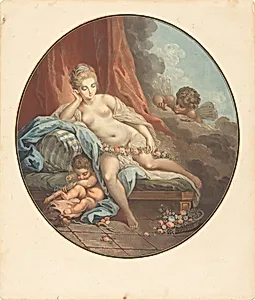
Venus en reflection
1751 to 1775
Medium
color aquatint
Classification
Department
CG-E
Museum
National Gallery of Art, Washington, D.C.
Credit
Widener Collection
Accession Number
1942.9.2383
Rights
Public Domain
Art Historical Context
**Venus en Reflection** Step into the enchanting world of 18th-century French art with *Venus en Reflection*, a exquisite color aquatint by-François Janinet, created after an original by Jacques Charlier between 1751 and 1775. This print captures the goddess Venus in a moment of intimate self-admiration, gazing into a mirror—a timeless motif symbolizing beauty, vanity, and the Rococo era's delight in mythological elegance and playful sensuality. Housed in the National Gallery of Art's Widener Collection (Department CG-E), it exemplifies how prints democratized high art, allowing collectors beyond the elite to savor such refined imagery. Janinet, a master engraver active in late 18th-century Paris, pioneered color aquatint, a revolutionary intaglio technique that mimics the soft, tonal gradations of watercolor or oil painting. Unlike traditional line engravings, aquatint uses resin-dusted plates etched in acid baths to produce velvety textures and vibrant hues, making this medium a bridge between painting and printmaking. Janinet's skillful layering of colors brought Charlier's composition to life with luminous depth, showcasing the technical innovation that elevated prints to collector's gems during the Enlightenment. This work reflects the cultural fascination with classical antiquity revived in Rococo France, where Venus embodied ideal femininity. As part of the prestigious Widener Collection, it invites us to ponder how such prints preserved and proliferated artistic beauty across generations. (218 words)