
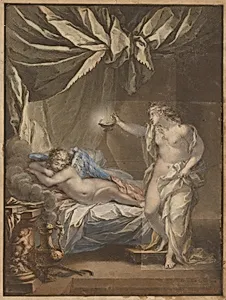
Cupid and Psyche
Medium
watercolor and gouache over black chalk and graphite on laid paper
Dimensions
overall: 38.7 × 29.4 cm (15 1/4 × 11 9/16 in.)
Classification
Drawing
Department
CG-E
Museum
National Gallery of Art, Washington, D.C.
Credit
William B. O'Neal Fund
Accession Number
2022.99.1
Rights
Public Domain
Art Historical Context
In the National Gallery of Art's collection, *Cupid and Psyche* (1800) by Italian artist Santino Tagliafichi the timeless myth of love's trials through a delicate preparatory drawing. Tagliafichi, a neoclassical sculptor and draftsman in Rome during the late 18th and early 19th centuries, drew inspiration from classical antiquity, much like his contemporaries Antonio Canova and Bertel Thorvaldsen. The subject—drawn from Apuleius's tale—depicts the divine lovers amid their fateful embrace, embodying Neoclassicism's reverence for mythological narratives, heroic ideals, and emotional depth at the cusp of Romanticism. Executed in watercolor and gouache over black chalk and graphite on laid paper (38.7 × 29.4 cm), this work showcases Tagliafichi's mastery of mixed media. The opaque gouache lends luminous highlights and rich tones to the figures' forms, while the underdrawing in chalk and graphite provides precise contours and subtle modeling. Laid paper, with its textured chains and wires, was a favored support for such virtuoso studies, allowing for intricate layering that blurred the line between sketch and finished composition. Acquired through the William B. O'Neal Fund, this drawing highlights the era's fusion of sculpture and draftsmanship, offering visitors a window into how artists like Tagliafichi planned grand marble works. Its survival as a standalone piece underscores the growing appreciation for drawings as independent art forms in the 19th century.