
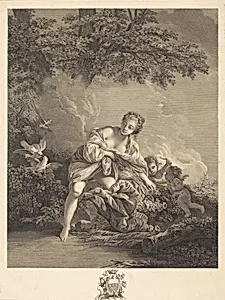
Venus et les amours
1701 to 1725
Medium
engraving and etching
Classification
Department
CG-E
Museum
National Gallery of Art, Washington, D.C.
Credit
Widener Collection
Accession Number
1942.9.2107
Rights
Public Domain
Art Historical Context
**Venus et les amours** is a delightful print by René Gaillard, created after an original design by the celebrated Rococo master François Boucher between 1701 and 1725. This enchanting scene captures Venus, the Roman goddess of love, surrounded by playful amours—likely cherubic Cupids—in a whimsical celebration of beauty and desire. Boucher's signature style shines through in the graceful, flowing forms and lighthearted eroticism typical of 18th-century French Rococo art, evoking the opulent world of Versailles under Louis XV. Rendered in engraving and etching, Gaillard's meticulous technique translates Boucher's painterly elegance into precise lines and soft tonal effects. Engraving provided sharp detail for Venus's voluptuous figure and the amours' dynamic poses, while etching added a freer, more atmospheric quality, mimicking the fluidity of oil paint. As a print from the Widener Collection at the National Gallery of Art (Department CG-E), it exemplifies how reproductive prints democratized high art, allowing Boucher's imagery to reach collectors and admirers across Europe. This work highlights Rococo's cultural allure, blending mythology with sensuality to reflect the era's indulgent tastes. A charming window into Enlightenment-era fantasy, it invites visitors to appreciate the artistry that made Boucher a favorite of royalty and the elite.