
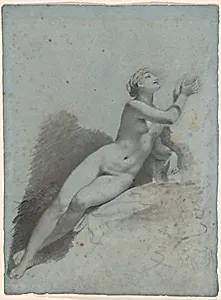
Venus
c. 1810-1812
Medium
black chalk with white chalk heightening on blue-gray paper
Dimensions
overall: 60.9 x 45.2 cm (24 x 17 13/16 in.)
Classification
Drawing
Department
CG-E
Museum
National Gallery of Art, Washington, D.C.
Credit
Ailsa Mellon Bruce Fund
Accession Number
1972.48.2
Rights
Public Domain
Art Historical Context
Pierre Paul Prud'hon’s *Venus* captures the timeless beauty of the Roman goddess of love through the artist’s masterful handling of chalk on paper. Created around 1810–1812, during the height of the First French Empire, this drawing reflects the neoclassical interest in classical mythology while revealing Prud’hon’s distinctive poetic sensibility. Often positioned between neoclassicism and emerging romanticism, Prud’hon favored intimate, luminous studies that emphasize grace and emotional resonance over strict academic rigidity. The medium itself is central to the work’s appeal. By combining black chalk with white highlights on cool blue-gray paper, Prud’hon achieves a remarkable sense of volume and soft, atmospheric light. The blue tone serves as a mid-value ground, allowing the white chalk to model form and suggest glowing skin, while the black chalk defines delicate contours. This technique, popular among French artists of the period, transforms a simple drawing into a finished work of art with almost painterly depth. Measuring roughly 24 by 18 inches, the sheet demonstrates Prud’hon’s ability to imbue mythological subjects with both ideal beauty and human warmth, inviting viewers to appreciate the quiet elegance of classical themes reimagined in the early nineteenth century.
About the Artist
Pierre Paul Prud'hon · 1758–1823
Pierre Paul Prud'hon (1758–1823) was a French painter and draughtsman whose dreamy, sensuous art occupied a singular position between the Neoclassicism and Romanticism that competed for dominance in French painting around 1800. Born in Cluny in Burgundy, he received his early artistic training at the Dijon Academy before winning the Prix de Rome of the Estates of Burgundy, which allowed him to spe...