
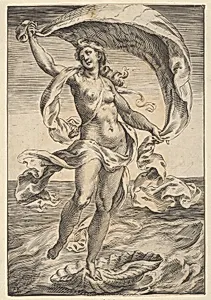
Venus on a half-shell, holding fabric over her head
17th century
Medium
Engraving (reverse copy)
Dimensions
Sheet: 8 3/16 × 5 5/8 in. (20.8 × 14.3 cm)
Classification
Prints
Department
Drawings and Prints
Museum
Metropolitan Museum of Art, New York, NY
Credit
The Elisha Whittelsey Collection, The Elisha Whittelsey Fund, 1951
Accession Number
51.501.3779
Rights
Public Domain
Tags
Art Historical Context
This delicate 17th-century engraving by Cherubino Alberti captures Venus, the Roman goddess of love and beauty, balanced gracefully on a scallop shell while lifting a length of fabric above her head. Alberti, an Italian printmaker known for his refined reproductive engravings, worked in the tradition of translating celebrated compositions into widely accessible prints. The work’s modest scale—just over eight inches tall—belies the careful attention to line and shading that conveys both the figure’s soft contours and the shell’s textured surface. As a reverse copy, the engraving mirrors an earlier design, a common practice that allowed artists to reinterpret famous motifs for new audiences. In the 1600s, prints like this one played a vital role in spreading Renaissance and classical imagery across Europe, bringing mythological subjects into homes and studios far from major collections. The theme of Venus emerging from the sea remained enduringly popular, symbolizing renewal, desire, and the enduring power of beauty. Today housed in the Metropolitan Museum’s Department of Drawings and Prints, the sheet offers visitors a tangible connection to the period’s fascination with antiquity and the technical artistry of engraving.
About the Artist
Cherubino Alberti (Zaccaria Mattia) · 1553–1615
Cherubino Alberti (1553–1615), also known by his birth name Zaccaria Mattia, was an Italian engraver and painter active in Rome during the late Renaissance and early Baroque periods. Born in Borgo San Sepolcro in Tuscany, he came from an artistically inclined family and received training that equipped him for work in both painting and the reproductive graphic arts. It was as a printmaker, however,...