
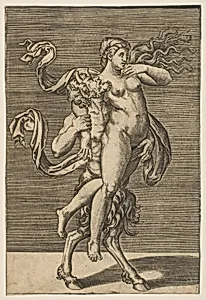
Satyr carrying a nymph restraining her right arm
Medium
Engraving
Dimensions
Sheet (Trimmed): 7 5/16 × 4 15/16 in. (18.6 × 12.5 cm)
Classification
Prints
Department
Drawings and Prints
Museum
Metropolitan Museum of Art, New York, NY
Credit
The Elisha Whittelsey Collection, The Elisha Whittelsey Fund, 1959
Accession Number
59.508.46
Rights
Public Domain
Tags
Art Historical Context
This enchanting engraving, titled *Satyr Carrying a Nymph Restraining Her Right Arm*, to around 1515–1600 and hails from anonymous Italian workshops, possibly inspired by the Mannerist master Giulio Romano. Created during the High Renaissance transitioning into Mannerism, it captures a playful yet charged mythological encounter between a lecherous satyr—half-man, half-goat, symbolizing untamed desire—and a resisting nymph, embodying elusive natural beauty and chastity. The trimmed sheet measures just 7 5/16 × 4 15/16 inches, making it an intimate, portable work now housed in the Metropolitan Museum of Art's Drawings and Prints department, thanks to The Elisha Whittelsey Collection. Engravings like this were revolutionary in the 16th century, allowing artists to disseminate designs widely across Europe through intricate copperplate techniques. Fine lines and cross-hatching convey dynamic motion: the satyr hoists the nude nymph over his shoulder as she pushes back, her gesture adding tension and erotic allure. Such scenes drew from classical antiquity, revived during the Renaissance to explore human passions, and reflect the era's fascination with the nude form, blending humor, sensuality, and moral allegory. A gem for lovers of mythology, this print highlights how prints democratized elite art, influencing everything from decorative arts to later Baroque fantasies. Spot the subtle details in her flowing hair and his muscular grip—timeless tales etched in metal.
About the Artist
Anonymous, Italian, 16th to early 17th century|Giulio Romano · 1500–1640
The artist known only as Anonymous, Italian, 16th to early 17th century, remains one of the many unidentified figures whose works survive in museum collections today. Active between roughly 1500 and 1640, this individual produced drawings, ornamental panels, and devotional subjects during a transformative period in Italian art that bridged the late Renaissance and the emerging Baroque. With no rec...