
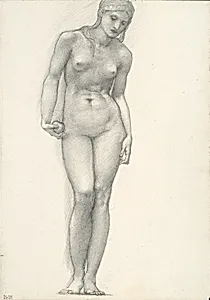
Venus with Golden Apple in Right Hand, for the Troy Triptych (sketchbook #2639)
c. 1873–77
Medium
Graphite on ivory wove paper
Dimensions
25.4 × 17.8 cm (10 × 7 1/16 in.)
Classification
graphite
Department
Prints and Drawings
Museum
Art Institute of Chicago
Accession Number
78959
Rights
Public Domain
Art Historical Context
In the hushed galleries of the Art Institute of Chicago's Prints and Drawings Department, visitors encounter a delicate gem from Sir Edward Burne-Jones's sketchbook: *Venus with Golden Apple in Right Hand, for the Troy Triptych* (c. 1873–77). This graphite drawing on ivory wove paper, measuring a modest 25.4 × 17.8 cm, captures the Pre-Raphaelite master's vision of the goddess Venus from Greek mythology. Burne-Jones, a leading figure in the Aesthetic Movement and a close collaborator with William Morris, was renowned for his ethereal, elongated figures inspired by medieval art and classical tales. Here, Venus cradles the fateful golden apple—symbol of discord from the Judgment of Paris myth—that would spark the Trojan War, hinting at the triptych's grand narrative. Crafted during Burne-Jones's prolific middle period, this preparatory sketch showcases his masterful graphite technique: fluid contours, subtle shading, and luminous highlights that evoke ivory's creamy warmth. Such drawings were vital to his process, bridging imagination and finished oil paintings or tapestries, often produced for the Morris & Co. firm. The intimate scale invites close inspection, revealing the artist's meticulous planning for larger compositions. This work embodies Victorian fascination with myth and beauty, blending sensuality with moral allegory. For Troy Triptych enthusiasts, it's a portal to Burne-Jones's dreamlike world, where ancient legends bloom anew on paper.
About the Artist
Sir Edward Burne-Jones · 1833–1898
Edward Coley Burne-Jones was born on 28 August 1833 in Birmingham, the son of a frame-maker, and lost his mother within a week of his birth. He attended King Edward VI Grammar School and the Birmingham School of Art before proceeding to Exeter College, Oxford, in 1852, intending to study theology. At Oxford he formed a lifelong friendship with William Morris, and the two young men became intoxicat...