
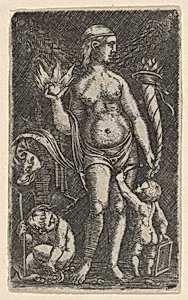
Venus with Two Putti
Medium
Engraving
Dimensions
Sheet: 2 3/8 × 1 7/16 in. (6.1 × 3.7 cm)
Classification
Prints
Department
Drawings and Prints
Museum
Metropolitan Museum of Art, New York, NY
Credit
Harris Brisbane Dick Fund, 1936
Accession Number
36.10
Rights
Public Domain
Tags
Art Historical Context
This delicate engraving, *Venus with Two Putti*, captures the Renaissance fascination with classical mythology in miniature form. The composition centers on Venus, the Roman goddess of love, accompanied by two playful putti—cherubic figures often symbolizing innocence and desire. Rendered in fine lines on a sheet just over two inches tall, the work demonstrates the precision possible in engraving, a technique that allowed artists to distribute intricate designs widely during the 15th and 16th centuries. Scholars have attributed the print to either Albrecht Altdorfer, a leading figure of the Northern Renaissance known for his atmospheric landscapes, or Peregrino da Cesena, an Italian engraver active in the same era. This dual attribution reflects the fluid exchange of artistic ideas across the Alps at the time. The small scale suggests it may have been intended for private contemplation or as part of a collector’s album rather than public display. Acquired by the Metropolitan Museum in 1936 through the Harris Brisbane Dick Fund, the print highlights how Renaissance artists revived ancient themes to explore human emotion and beauty. Its intimate size invites close viewing, revealing the subtle interplay between the central figure and her lively companions.
About the Artist
Albrecht Altdorfer|Peregrino da Cesena · 1475–1538
Albrecht Altdorfer (c. 1480–1538) was a German painter, printmaker, and draftsman who stands as one of the founders of landscape painting as an independent genre. Born in Regensburg or nearby Altdorf, he learned art from his father Ulrich, a painter and miniaturist. Altdorfer spent most of his life in Regensburg, becoming a citizen in 1505 and later serving as the city's official architect and a m...