
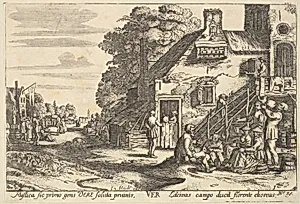
Ver (Spring)
Medium
Etching; third state of three
Classification
Prints
Department
Drawings and Prints
Museum
Metropolitan Museum of Art, New York, NY
Credit
The Elisha Whittelsey Collection, The Elisha Whittelsey Fund, 1951
Accession Number
51.501.5442
Rights
Public Domain
Tags
Art Historical Context
"Ver (Spring)" is delicate etching capturing the vibrancy of the season, attributed to Dutch artist Jan van de Velde (1593–1641) and Bohemian etcher Wenceslaus Hollar (7–1677). in 1629, this third and final state of the plate depicts a lively spring scene with men and women amid quaint houses, evoking the renewal of nature and everyday rural life during the Dutch Golden Age. Van de Velde, renowned for his innovative genre scenes and landscapes, likely provided the original design, while Hollar's masterful reproduction highlights their collaborative spirit in printmaking. Etching, the medium here, allowed for fluid, expressive lines etched into a copper plate with acid, revolutionizing print production in the 17th century by enabling artists to achieve painterly effects unattainable in engraving. The "third state" refers to the plate's refined version, with added details enhancing depth and texture, making it a prized example of reproductive printmaking—where Hollar faithfully interpreted van de Velde's vision for wider dissemination. Housed in the Metropolitan Museum of Art's Drawings and Prints department as part of The Elisha Whittelsey Collection (acquired 1951), this work underscores the era's fascination with seasonal themes and the democratization of art through prints. It invites visitors to appreciate how such images brought the joys of spring into homes across Europe, blending technical prowess with timeless human connection to the land.
About the Artist
Jan van de Velde II|Wenceslaus Hollar · 1593–1641
Jan van de Velde II (1593–1641) was one of the most accomplished Dutch printmakers and draughtsmen of the early seventeenth century, born in Haarlem into a dynasty of celebrated calligraphers and artists. His father, Jan van de Velde I, was a renowned writing master, and his cousin Willem van de Velde the Elder would later become a distinguished marine painter. Jan II studied engraving under Jacob...